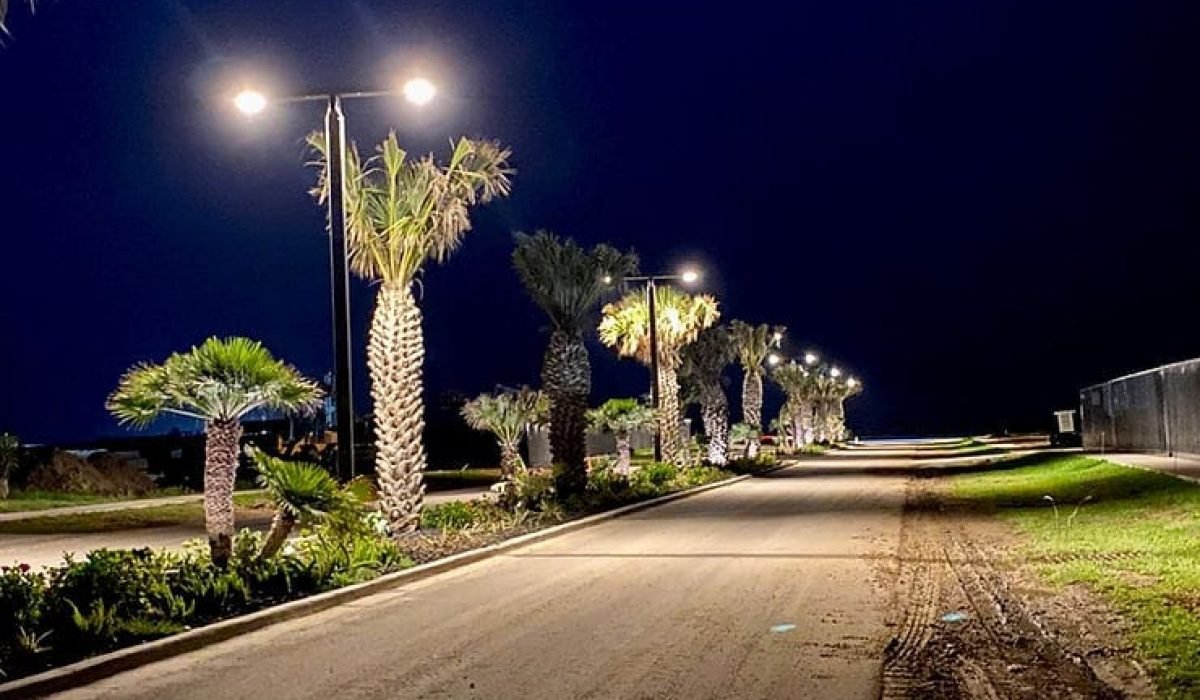
Solar street lights with cameras combine lighting, power supply, and site monitoring in one system. In practical terms, they are used where a project needs both nighttime visibility and basic surveillance coverage, especially in roads, parks, compounds, campuses, industrial sites, and remote public areas.
For EPC contractors, municipalities, and public-infrastructure buyers, the value of this system is not simply that it “looks smart.” The real value is that it can support lighting + monitoring + off-grid deployment in one coordinated installation.
Quick Answer
Solar street lights with cameras work by using a solar panel to collect energy during the day, storing that energy in a battery, and then using the stored power to operate both the LED luminaire and the camera system according to the controller settings.
A typical system includes:
- solar panel
- battery
- LED luminaire
- controller
- pole and mounting structure
- surveillance camera, sometimes with communication or remote-monitoring functions
The key engineering point is this: a camera-enabled solar street light is not just a normal solar light with a camera attached. The lighting load, camera load, battery sizing, autonomy target, and control logic all need to be reviewed together.
Need help checking whether a camera-enabled solar lighting system fits your road, compound, park, or public project?
Explore Solutions
Request Engineering Support (24H)
Why This Matters
In many outdoor projects, lighting and security are reviewed together rather than separately.
A municipal road may need both:
- illumination for safer nighttime movement
- monitoring for public-space management
A compound or industrial site may need:
- perimeter or access-road lighting
- visual coverage of key points after dark
A remote or developing-area project may need:
- off-grid lighting because grid extension is difficult
- camera support because security staffing is limited
That is why solar street lights with cameras are increasingly considered in:
- municipal and development-oriented projects
- smart-city or monitored public-space upgrades
- campuses and institutional sites
- warehouses, yards, and logistics compounds
- parks and public access roads
- remote roads or corridor lighting projects
The real question is not whether the product sounds advanced. The real question is whether the system can deliver both lighting performance and monitoring function under the site’s actual solar, battery, environmental, and maintenance conditions.
How Do Solar Street Lights with Cameras Function?
These systems operate by collecting solar energy during the day and using stored battery energy to power lighting and surveillance functions when solar input is unavailable.
The basic working sequence is usually:
- Daytime charging — the solar panel collects sunlight and charges the battery.
- Energy storage — the battery stores enough energy for lighting and camera use.
- Nighttime operation — the LED luminaire turns on according to the programmed logic, and the camera operates according to the project design.
- Control logic — some systems include dimming, motion sensing, scheduled operation, or remote monitoring to manage energy use.
In real projects, the most important issue is not the sequence above. It is whether the system has been sized correctly for the total load.
The Main Components of Solar Street Lights with Cameras
1. Solar Panel
The solar panel converts sunlight into electricity during the day.
Its practical performance depends on:
- panel size
- site solar resource
- orientation and tilt
- shading risk
- local weather conditions
If the panel is too small for the lighting and surveillance demand, the system may struggle in cloudy periods or lower-irradiation seasons.
2. Battery
The battery stores energy for night operation.
In camera-enabled systems, battery sizing is more critical than in standard solar street lights because the system may need to support:
- LED lighting load
- camera load
- communication modules
- motion sensing or control features
- autonomy requirements during poor-weather days
This is one reason why integrated systems should not be evaluated by lamp wattage alone.
3. LED Luminaire
The LED luminaire provides roadway, pathway, or area illumination.
For solar applications, LED technology is widely used because it offers:
- high energy efficiency
- lower power draw
- longer service life
- better compatibility with battery-powered systems
The luminaire should still be selected according to the application, including road width, pole height, spacing, and target lighting level.
4. Controller
The controller manages charging and discharging behavior and determines how the stored power is used.
More advanced controller logic may include:
- dimming schedules
- motion-triggered brightness changes
- battery protection
- operating-time programming
- remote status reporting
5. Camera System
The camera adds surveillance capability to the lighting system.
Depending on the project, the camera may include:
- motion detection
- night vision
- image or video recording
- real-time remote viewing
- alarm or event-triggered monitoring
From an engineering point of view, the most important issue is that the camera power demand must be included in the system energy balance.
6. Pole and Mounting Structure
The pole structure remains important because the camera, bracket, and any communication hardware can change the loading condition.
The project should review:
- pole height
- bracket arrangement
- wind exposure
- mounting position of the camera
- structural loading
- foundation coordination
For related project pathways, see:
Product Categories
Engineering Support
Working Logic in Real Projects
Daytime Operation
During the day, the panel charges the battery. In a properly designed system, the daytime charging profile must cover both the lighting demand and the surveillance-related demand.
Nighttime Operation
At night, stored battery energy powers the LED luminaire and camera system.
Common operating strategies include:
- full-night lighting
- dimming during off-peak hours
- motion-triggered brightness increase
- scheduled camera operation
- remote-monitored system control
Why the Energy Balance Matters
In standard solar street lights, the design is often centered on luminaire wattage and operating hours.
In systems with cameras, the design also needs to consider:
- additional camera power draw
- communication-device load
- data transmission logic
- longer runtime expectations
- reserve margin for cloudy weather
This is often where underperforming systems fail: the camera is added, but the power system is not adjusted accordingly.
Comparison: Standard Solar Street Light vs Solar Street Light with Camera
| Item | Standard Solar Street Light | Solar Street Light with Camera |
|---|---|---|
| Main Function | Lighting | Lighting + surveillance |
| Power Demand | Lower | Higher |
| Battery Requirement | Standard | Usually higher |
| Design Complexity | Lower | Higher |
| Best Fit | Roads, parks, pathways | Roads, compounds, monitored public areas |
| Review Focus | Lighting performance | Lighting + monitoring + autonomy |
This comparison is useful because it shows why camera-enabled systems need more careful project review.
Advantages of Solar Street Lights with Cameras
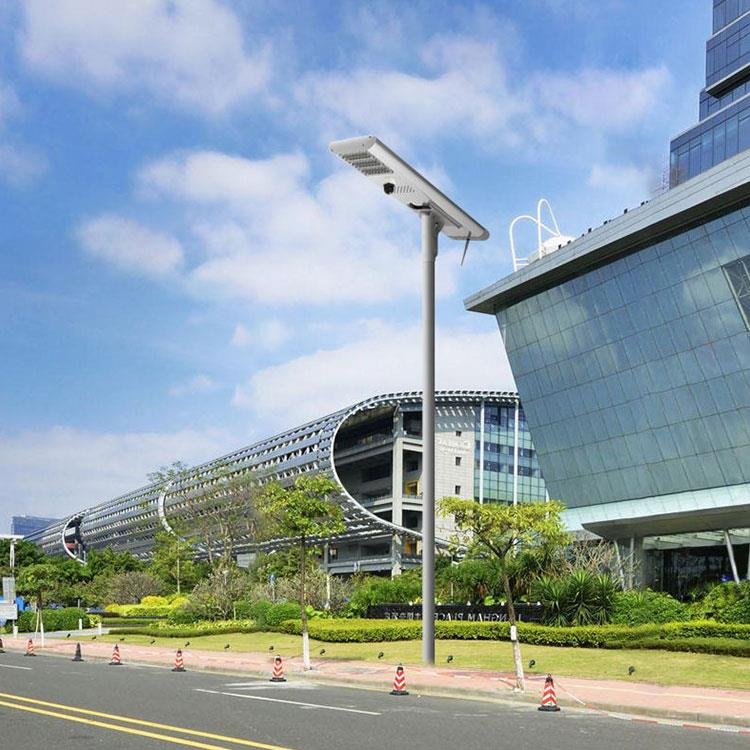
ALT: solar street light with integrated camera used for outdoor lighting and site monitoring
Caption: In integrated systems, the value comes from combining lighting coverage and monitoring capability in one infrastructure point.
1. Combined Lighting and Security Function
One installation can serve both illumination and site monitoring, which can simplify the infrastructure logic in selected applications.
2. Lower Grid Dependence
Because the system is solar-powered, it can be useful in sites where:
- grid access is weak
- trenching and cabling are expensive
- utility coordination is slow
- blackouts are common
3. Better Fit for Remote or Expanding Areas
In remote roads, compounds, and peri-urban development areas, integrated solar lighting can be easier to deploy than conventional lighting plus a separate surveillance structure.
4. Efficient Use of Infrastructure Points
Instead of installing one pole for lighting and another structure for monitoring, some projects prefer one coordinated solution.
5. Lifecycle Logic in the Right Applications
The upfront cost may be higher than a standard solar street light, but some projects justify the solution through:
- reduced grid dependency
- combined lighting and monitoring function
- simplified infrastructure rollout
- better coverage for public or site-management needs
Where Solar Street Lights with Cameras Are Commonly Used

ALT: solar street lighting system with camera used for public security or smart outdoor infrastructure
Caption: Camera-enabled solar street lights are often considered where nighttime visibility and site oversight are both important.
These systems are often used in:
- public roads and intersections
- parks and squares
- campuses and institutions
- parking areas
- industrial sites and logistics compounds
- municipal corridors
- remote access roads
- monitored public facilities
For reference projects and market context, see:
Projects
Markets We Serve
Key Factors Before Selecting a Solar Street Light with Camera
Before selecting this type of system, the project should review several factors clearly.
1. Lighting Requirement
The road or area still needs adequate lighting performance. Camera integration does not replace proper lighting design.
2. Surveillance Requirement
The project should define what the camera is expected to do:
- provide basic visual coverage
- monitor an access point
- support event-triggered recording
- provide remote viewing
Not every project needs the same surveillance level.
3. Battery Autonomy
The system should be sized for realistic operating conditions, including cloudy days and seasonal variation.
4. Solar Resource and Climate
Local weather and irradiation conditions affect whether the system can reliably support both loads.
5. Maintenance Access
If the site is remote or maintenance access is limited, the design should include more margin and a simpler service logic.
6. Pole and Foundation Suitability
The added camera and mounting hardware may affect pole loading and foundation requirements.
Common Mistakes in Camera-Enabled Solar Lighting Projects
Treating the Camera as a Small Add-On
In many cases, the camera and communication load are not negligible. If the system is sized only for lighting, performance may become unstable.
Looking Only at Lamp Wattage
For this type of project, the correct review should include total system demand, not just the LED power.
Ignoring Real Autonomy Requirements
Some projects assume standard nightly operation without reviewing how many cloudy days or low-sun periods the site experiences.
Focusing on Product Features Without Reviewing the Site
A feature-rich product description is not enough. The real site conditions still determine whether the system will perform reliably.
Overlooking Documentation and QC
Public and contractor-led projects usually need more than a brochure. They often need:
- configuration clarity
- quality-control logic
- component coordination
- project-fit documentation
Review Basis: What Buyers and Engineers Usually Check
For EPC, municipal, and infrastructure projects, the review usually covers more than product features.
Common review questions include:
- Is the solar panel sized correctly for the total load?
- Is the battery capacity realistic for the required autonomy?
- Is the lighting output suitable for the road or area?
- Is the camera function aligned with the actual use case?
- Is the pole structure adequate for the mounted equipment?
- Is the system practical to maintain after handover?
If the system is undersized or poorly matched to the site, the result may be:
- reduced runtime
- unstable monitoring
- weak cloudy-day performance
- faster battery stress
- complaints after commissioning
That is why engineering support matters.
If you need application review, BOQ alignment, lighting simulation context, or project-fit recommendations, start here:
Engineering Support Hub
Quality Control and Documentation Matter Too
For serious projects, product quality and documentation are part of the buying decision.
Buyers often want to understand:
- how the system is configured
- whether the battery, controller, and camera logic are coordinated
- how QC is handled
- whether the supplier can support project review and after-sales follow-up
You can review more on this side here:
Manufacturing & Quality
Conclusion
Solar street lights with cameras combine renewable energy, outdoor lighting, and surveillance capability in one system. When designed correctly, they can improve nighttime visibility, support site monitoring, reduce grid dependence, and simplify deployment in selected outdoor applications.
They are especially relevant for projects that need both lighting and monitoring coverage in roads, compounds, public areas, campuses, industrial sites, or remote corridors.
The main decision point is not whether the product sounds advanced. It is whether the configuration is properly matched to:
- the site environment
- the lighting requirement
- the monitoring requirement
- the autonomy target
- the maintenance reality
- the project budget
That is where engineering review and clear documentation make the real difference.
Need Help With a Solar Street Light and Camera Project?
If you are evaluating solar street lights with cameras for a road, park, parking area, public compound, industrial site, or municipal project, the next step is usually to confirm whether the system can meet both the lighting and monitoring requirement under the real site conditions.
Next actions:
- Explore Solutions
- View Product Options
- See Project References
- Request Engineering Support (24H)
- Review Manufacturing & Quality
- See Markets We Serve
FAQ
How do solar street lights with cameras work?
They use solar panels to generate electricity during the day, store the energy in batteries, and then use that stored power to operate both the LED light and camera system according to the project’s control logic.
Do solar street lights with cameras work at night?
Yes. They are designed to use stored battery energy at night so the lighting system and camera can continue operating when solar input is unavailable.
Are solar street lights with cameras good for public security?
They can be useful for public security because they combine lighting and surveillance in one system, especially in parks, roads, compounds, and public spaces where visibility and monitoring are both important.
Do cameras make solar street lights use more battery power?
Yes. The camera and any communication modules add extra power demand, which means the battery and solar charging design should account for more than lighting alone.
Where are solar street lights with cameras commonly used?
They are commonly used in public roads, parks, parking areas, industrial sites, campuses, municipal projects, and remote areas where combined lighting and monitoring are needed.