Wind Resistance Grades for Lighting Poles
Notes from 15 years of projects across East & Central Africa — where wind, steel, procurement shortcuts, and sometimes stubborn consultants all collide in the
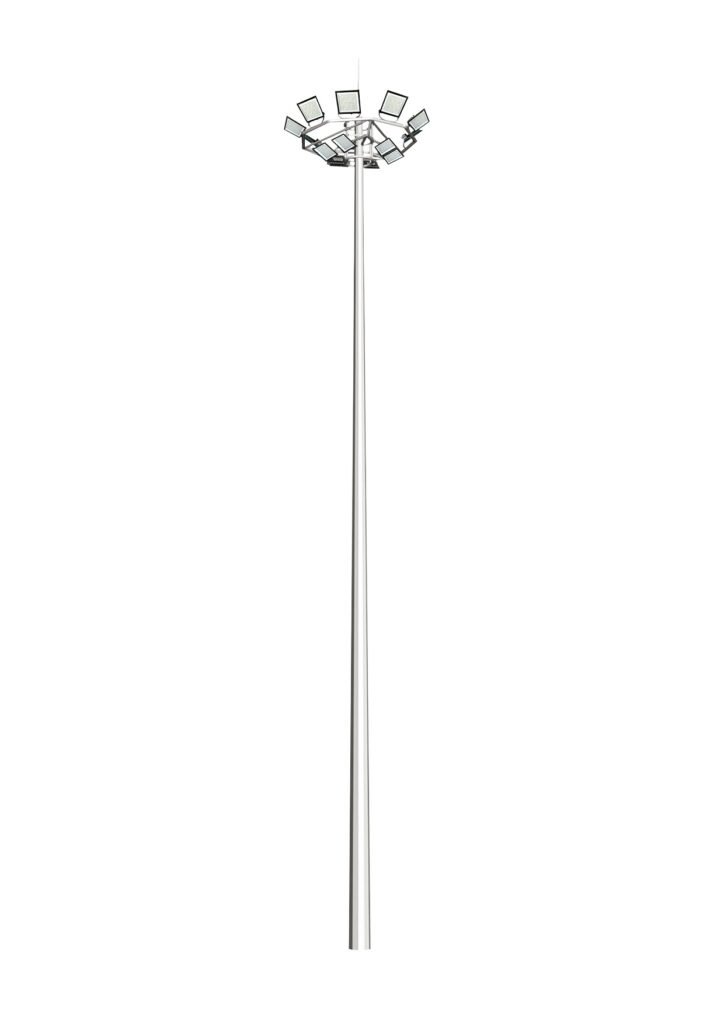
Designing a high-mast lighting system is never a theoretical exercise — it is a balance between optical precision, structural resilience, and real-world maintenance. Recent field projects in coastal and desert regions have shown that engineers often face conflicting requirements between glare control and wind load resistance. When luminaires are tilted for better coverage, their effective projected area (EPA) increases, magnifying structural stress. This whitepaper explores how Sunlurio HMS™ (High-Mast Simulation Suite) resolves those conflicts through integrated design simulation — aligning photometry, mechanics, and intelligent control in one workflow.
Each environment brings its own constraint set — limited pole locations, high wind exposure, or strict glare limits — which HMS™ allows designers to quantify before fabrication begins.
E = Σ[(I_i × cos³θ_i) / h²]
In high-mast geometry, every degree of tilt changes the cosine³ θ term significantly. Field experience shows that a 5° aiming deviation can alter ground lux by more than 8 %, hence accurate aiming calibration is critical during commissioning.
U₀ = E_min / E_avg ≥ 0.4 L = (E × ρ) / π
Uniformity defines perceived brightness continuity — vital in large truck yards where alternating bright and dark zones can fatigue drivers’ eyes.
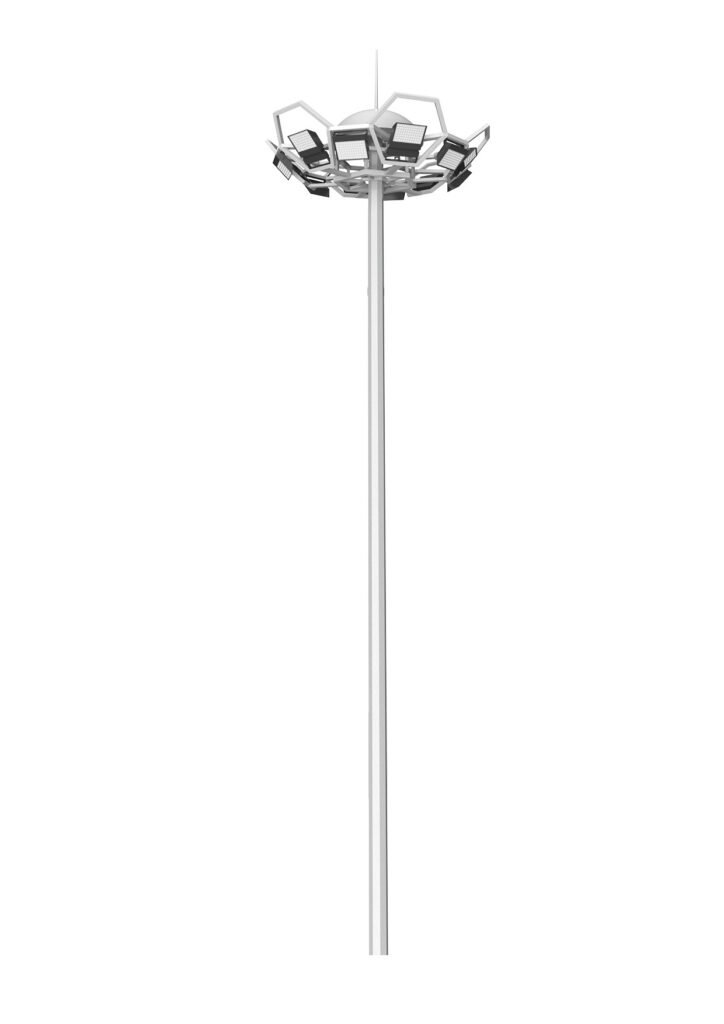
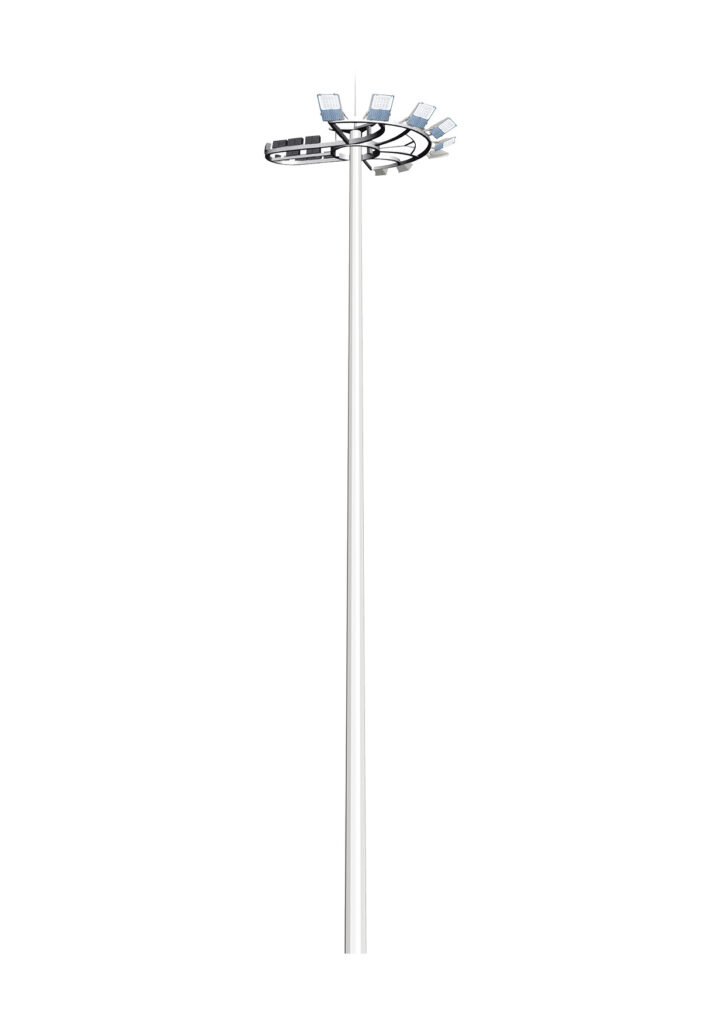
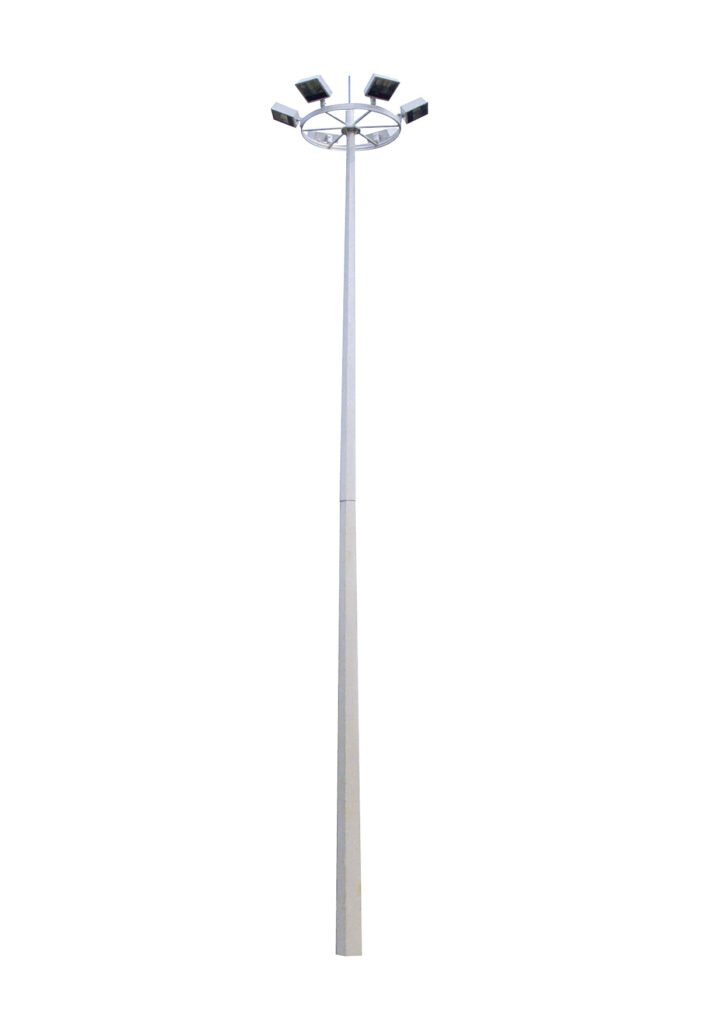
Sunlurio HMS™ is more than a calculation engine; it is a digital workbench engineers use daily. In practice, designers import site geometry, simulate light spread, and even visualize mast deflection during typhoon scenarios. The software merges photometric analysis, structural stress mapping, and dimming control into one continuous loop.
| Module | Purpose | Practical Output |
|---|---|---|
| Photometric Engine | Generates lux maps and glare analysis from IES/LDT imports | Uniformity charts, isolux diagrams |
| Structural Load Analyzer | Performs wind and stress simulation on pole geometry | Deflection (mm), stress (MPa), safety margin |
| Optic Aiming Simulator | Optimizes tilt and rotation for each luminaire ring | Aiming configuration (.HMA file) |
| Dimming Scheduler | Builds adaptive control profiles tied to traffic and weather data | .HDS schedule for IDS/HMS controllers |
Engineers typically iterate through two to three HMS™ runs before reaching an optimum — reducing luminaire count by up to 15 % without losing uniformity.
Field experience suggests that even minor variations in wind classification change design outcomes dramatically. In coastal zones, thicker walls and wider bases are mandatory despite the same illuminance target.
High-mast optics must reconcile beam overlap with glare suppression. Engineers often prefer mixed distributions — narrow (10°) for distant lanes, medium (30°) for mid-zones, and wide (60°) for apron areas — all verified in HMS™ through a composite lux overlay.
The electrical backbone is designed for resilience. Each mast integrates surge-protected circuits and IoT gateways that sync to the Sunlurio Cloud. During field calibration, sensors are fine-tuned to prevent overreaction to brief motion or vehicle flashes.
Intelligent dimming allows real-time adaptation to ambient and operational conditions. HMS™ integrates with Sunlurio IDS™ logic so that luminaires automatically shift output levels according to traffic sensors or astro-timers.
| Time | Condition | Output % | Notes |
|---|---|---|---|
| 18:30–22:00 | Normal traffic | 100 | Full visibility |
| 22:00–00:00 | Moderate traffic | 70 | Automatic dimming |
| 00:00–05:00 | Low traffic | 40 | Energy-saving mode |
| Rain/Fog | Weather sensor | +20 | Contrast enhancement |
Annual verified saving: 48–55 % compared to static operation — confirmed through on-site power meter logs.
Site: Coastal port yard (48 m × 160 m). 30 m mast with 8 × 400 W LED luminaires (Type V). Target E_avg ≈ 40 lx, U₀ ≥ 0.5, V_design = 45 m/s.
HMS™ Results:
Measured values during on-site testing deviated less than 2.5 % from simulation predictions, confirming model fidelity under real wind and temperature conditions.
High-mast lighting sits at the intersection of civil, electrical, and optical engineering. Simulation makes precision achievable, but field variability — wind gusts, corrosion, voltage fluctuations — constantly tests theory. Our ongoing challenge remains balancing precision with practicality: ensuring every mast performs reliably under unpredictable real-world conditions while maintaining photometric integrity and energy efficiency. With the HMS™ digital twin workflow, Sunlurio continues refining this balance, turning each project into measurable progress for safer, smarter outdoor environments.
Prepared by the Sunlurio Structural & Illumination Engineering Division. The division combines structural mechanics, photometric modeling, and IoT control expertise to deliver verified high-mast lighting systems across Africa, Southeast Asia, and the Middle East. Sunlurio HMS™ forms part of the company’s global simulation ecosystem linking design, analysis, and intelligent operation.

Notes from 15 years of projects across East & Central Africa — where wind, steel, procurement shortcuts, and sometimes stubborn consultants all collide in the

Executive Summary This report presents a comprehensive documentation of the planning, design, implementation, and performance evaluation of the 200-unit Solar Street Lighting Project deployed across

1. A Simple Story: The Night My Garden Went Dark Last month, a client from Kisumu called me about her garden lights. “They just died
WhatsApp us

Inside the Catalog:
Download our comprehensive catalog to explore our wide range of street lights and solar street lights, designed to meet the highest standards of quality and efficiency.