A Guide to Understanding Lighting Maintenance Factor (MF)

Table of Contents

LED-Football-field-lighting

A Guide to Understanding Lighting Maintenance Factor (MF)

Quick Answer (30 seconds):
Lighting Maintenance Factor (MF) is the “reality correction” used in lighting design. It tells reviewers how much light will remain after aging, dirt, failures, and surface darkening — so your project still meets the target lux years later, not only on day one.

✅ If you are preparing an EPC/government submission and need DIALux/Relux report + IES files + BOQ mapping, request a tender-ready pack:
Request Engineering Deliverables (24H)


Table of Contents (Click to Expand)

- [What’s Inside a Tender-Ready Deliverables Pack (1 Table)](#whats-inside-a-tender-ready-deliverables-pack-1-table)
- [Who This Guide Is For (EPC / Government / Consultants)](#who-this-guide-is-for-epc--government--consultants)
- [Why I Stopped Treating MF as “Just a Number”](#why-i-stopped-treating-mf-as-just-a-number)
- [What the Lighting Maintenance Factor Actually Means](#what-the-lighting-maintenance-factor-actually-means)
- [Design Basis & Standards (Audit-Friendly)](#design-basis--standards-audit-friendly)
- [Breaking Down the Four Factors That Make Up MF](#breaking-down-the-four-factors-that-make-up-mf)
- [Putting It All Together (A Simple Example)](#putting-it-all-together-a-simple-example)
- [How We Choose a Reasonable MF (Evidence-Based)](#how-we-choose-a-reasonable-mf-evidence-based)
- [MF in Solar Street Lighting Projects (Tender & Acceptance)](#mf-in-solar-street-lighting-projects-tender--acceptance)
- [How to Keep the Maintenance Factor Higher (Practical Checklist)](#how-to-keep-the-maintenance-factor-higher-practical-checklist)
- [Why the Lighting Maintenance Factor Deserves More Respect](#why-the-lighting-maintenance-factor-deserves-more-respect)
- [Due Diligence Links (For Tender Reviewers)](#due-diligence-links-for-tender-reviewers)
- [FAQ (Common Questions from EPC & Consultants)](#faq-common-questions-from-epc--consultants)
- [Get a Tender-Ready Pack in 24H (CTA)](#get-a-tender-ready-pack-in-24h-cta)
- [Contact Us (Faster Reply Guide)](#contact-us-faster-reply-guide)
- [Related Pages (Internal Links)](#related-pages-internal-links)


What’s Inside a Tender-Ready Deliverables Pack (1 Table)

Deliverable What reviewers check Most common failure
BOQ + mapping Model/qty/specs are auditable BOQ cannot map to IES/DIALux
IES photometric files Exact model + optics + tilt Generic / wrong optics / wrong mounting
DIALux/Relux report Lux + uniformity + layout proof Assumptions unclear / no IES reference
Datasheets & drawings Spec proof + installation feasibility Missing key attachments
Due diligence files (on request) Factory + compliance + references Wrong documents for buyer type

Note: final criteria always follow the tender’s stated standard and reporting format (e.g., EN 13201 or IESNA RP-8).


Who This Guide Is For (EPC / Government / Consultants)

Use this guide if you are:

  • Reviewing a roadway / municipal / industrial lighting design and want results that still hold after depreciation.
  • Doing DIALux/Relux calculations and need a defensible MF assumption for approval.
  • Preparing an EPC/government submission and want to avoid rejection + redesign loops.
  • Comparing suppliers and need audit-proof logic, not marketing claims.

Why I Stopped Treating MF as “Just a Number”

I still remember my first warehouse lighting audit in Nairobi back in 2013 — everything looked perfect on paper: 500 lux average, good uniformity, all within spec. Six months later, the client called: “It’s too dark near the packing lines.” We checked. Lamps hadn’t failed — they’d just aged, collected dust, and lost almost 25% of their light. That’s when the Lighting Maintenance Factor (MF) stopped being a theory and became something painfully real.

If you are using DIALux/Relux for EPC work, MF is one of the most “quiet” parameters — and one of the most likely to create acceptance disputes later.
For tender-grade designs, we normally package MF assumptions together with IES files and calculation settings:
Request DIALux Simulation Outputs


What the Lighting Maintenance Factor Actually Means

The lighting maintenance factor (MF) is the ratio between maintained illuminance and initial illuminance — showing how much light remains after aging, dirt, failures, and surface degradation over time.

Designing for 500 lux on day one is easy. Keeping it close to 500 after three years of forklift exhaust, oil mist, and poor cleaning is the real trick. MF tells you how optimistic or honest your design is.

Typical MF values I’ve seen:

  • Clean office or hospital → around 0.9
  • Warehouse or light industry → roughly 0.8
  • Outdoor yards or dusty sites → 0.7 or lower

People often want MF = 1.0 — but that’s fantasy. You always lose some light. The question is how quickly, and how you plan for it.

Formula we usually start with:
MF = LLMF × LMF × LSF × RSMF


Design Basis & Standards (Audit-Friendly)

To keep the design reasonable, compliant, and reviewable, the deliverables pack follows the tender-stated standard first. If the tender does not specify, we align to commonly accepted roadway lighting references and clearly state all assumptions in the report.

Common road lighting references (examples)

  • EN 13201 (Road lighting, Europe) — defines lighting classes, calculation grids, and evaluation metrics (average illuminance/luminance, uniformity, glare limits).
  • IESNA RP-8 (Roadway lighting, North America) — provides roadway lighting practice, typical target levels, and evaluation approach.

What we document in every report (so reviewers can trace it)

  • Target criteria used (lux / uniformity / glare or spill if required)
  • Geometry inputs (road width, lanes, pole height, spacing, arm length, tilt)
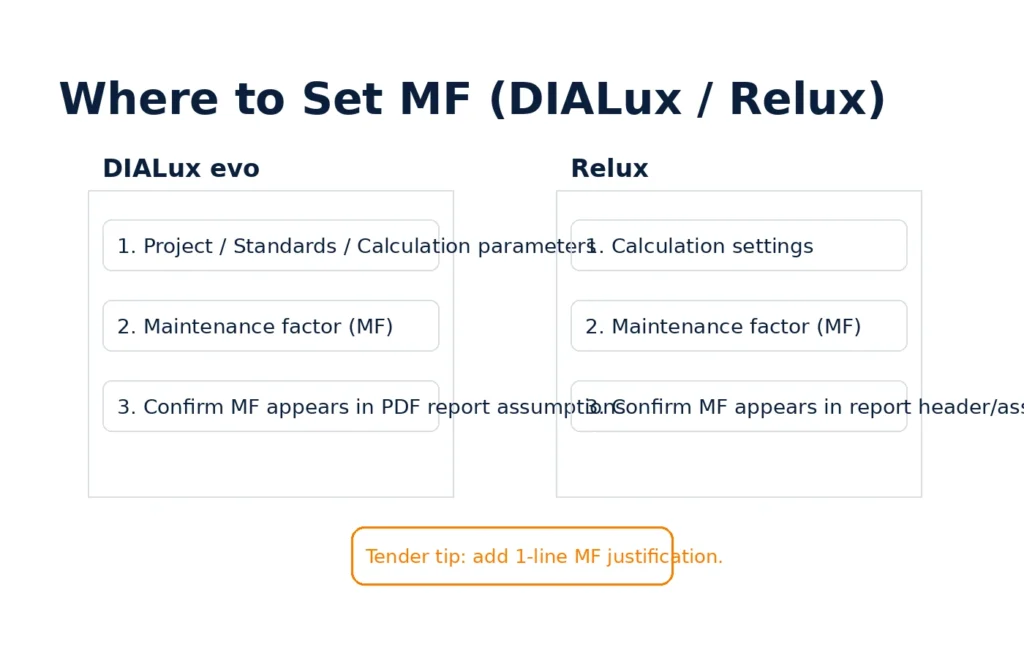
  • Calculation settings (maintenance factor, grid, surface assumptions)
  • Photometric reference (IES/LDT file name + model/optics mapping)
  • Pass/Fail summary against the selected criteria

Breaking Down the Four Factors That Make Up MF

The four elements—LLMF, LMF, LSF, and RSMF—represent lumen decay, dirt accumulation, lamp survival, and reflectance loss — and together they define how fast brightness declines in real installations.

On drawings, they look neat and exact. In practice, they’re judgment calls backed by field experience more than lab data.

1) Lamp Lumen Maintenance Factor (LLMF)

LLMF measures how much brightness a lamp retains after thousands of hours of use; it depends on LED quality, operating temperature, and driver stability.

A solid LED keeps about 90% output after 50,000 hours (L90). A cheaper one can drop below 0.8 in half that time. Metal halides fade even faster.

I once compared two “identical” LED fixtures in a textile mill. Same driver, same rating — one row looked duller after 18 months. Testing showed 17% lower lumens. Since then, I never trust a spec sheet that doesn’t list temperature test points.

If you’re evaluating luminaires for a project submission, ask for auditable datasheets (model + wattage + optics + test references):
Request Datasheets Pack

2) Luminaire Maintenance Factor (LMF)

LMF indicates how dirt, dust, and insect buildup reduce a luminaire’s light transmission between cleanings.

This one varies wildly by environment. In clean offices, 0.95 is realistic. In a cement plant? You’ll fight to stay at 0.65 unless you clean monthly.

We once opened floodlights in a depot that hadn’t been cleaned for years — the glass was brown, cutting 40% of output. No simulation predicted that.

Choose IP65+ luminaires for dusty or coastal sites. Pay a bit more now, or clean twice as often later. Your call.

3) Lamp Survival Factor (LSF)

LSF represents the percentage of lamps still working after a certain time — covering failures from drivers, wiring, or environment.

LEDs rarely “burn out,” but cheap drivers do. In one parking project, 12% failed in the first year due to heat inside sealed poles. Since then, I derate aggressively for confined spaces.

Typical real values:

  • Quality LED fixtures: 0.95–0.98
  • HID or fluorescent: 0.85–0.95

Whenever a supplier says “LSF = 1.0,” I smile and double the warranty clause.

4) Room Surface Maintenance Factor (RSMF)

RSMF measures the drop in reflected light as walls and ceilings darken with dust, smoke, or time.

Even in offices, paint yellows and dust dulls surfaces. In factories, especially with diesel forklifts, I’ve seen white walls turn gray within a year — reflectance down by 20%.

A repaint can do wonders. In one workshop, simply washing the ceiling raised measured lux by 15%. It’s the cheapest light upgrade you can buy.


Putting It All Together (A Simple Example)

The overall MF is the product of the four sub-factors, and it tells you how much initial light you must design to achieve the target lux after depreciation.

Let’s say:
LLMF = 0.9, LMF = 0.8, LSF = 0.95, RSMF = 0.9

MF = 0.9 × 0.8 × 0.95 × 0.9 = 0.62

If the required maintained illuminance is 500 lux, you’ll need roughly 800 lux at installation.
New designers always ask, “Why oversize?” Because dust and time don’t care about your spreadsheet.

If you want us to verify these assumptions in a report (with IES references and settings clearly listed), request:
Request DIALux Simulation Outputs


How We Choose a Reasonable MF (Evidence-Based)

MF is not a “random 0.8”. In tender-grade design, MF should be selected based on:

  • Environment (clean / dusty / coastal / industrial fumes)
  • Luminaire sealing (IP rating, optical chamber design)
  • Cleaning plan (none / yearly / quarterly)
  • LED/driver quality & thermal design (expected lumen depreciation and failure rate)
  • Surface conditions (reflectance change and surrounding dust)

Audit note: the selected MF and its rationale are written in the DIALux/Relux report and can be reviewed by the tender committee.


MF in Solar Street Lighting Projects (Tender & Acceptance)

This is the part many teams miss: MF matters even more in solar street lighting tenders, because the committee is usually concerned about acceptance risk — “Will this still meet the target after seasons, dust, and real-world operation?”

In solar street lighting projects, MF-related disputes often come from:

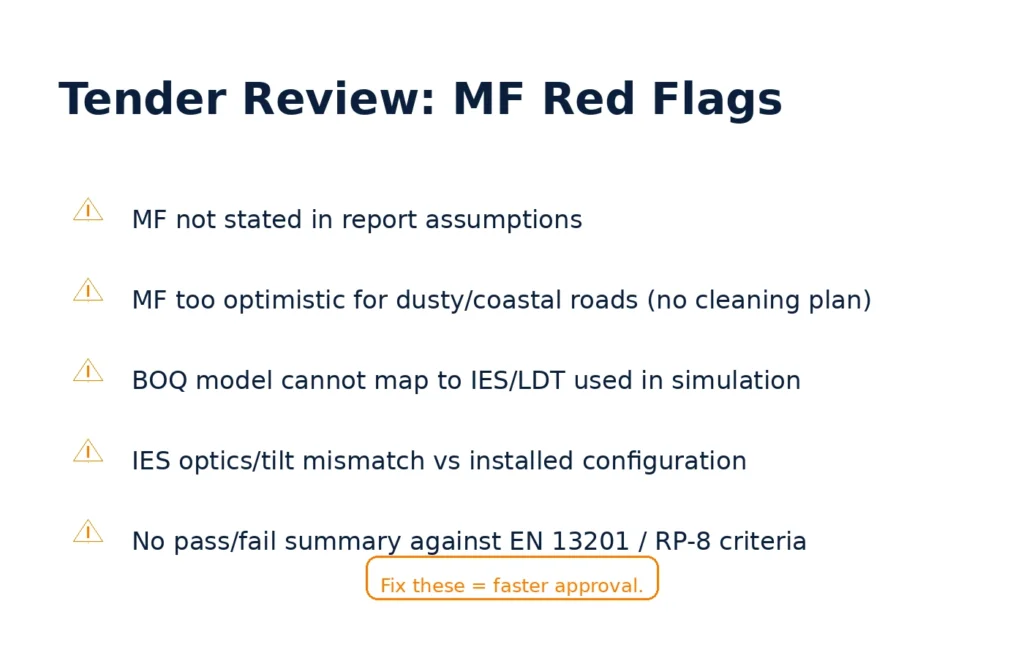
  • Using generic IES files that don’t match the actual optics or mounting tilt
  • Not stating calculation assumptions (grid, maintenance factor, luminaire tilt, pole spacing)
  • “Marketing brightness claims” without traceable deliverables (IES + DIALux + datasheet mapping)

That’s why we package tender submissions as a consistent set:

  • BOQ mapping → IES references → DIALux/Relux report → datasheets (audit layer)

Start here if you need the full pack:
Tender Documents & BOQ
IES Photometric Files
Lighting Design Service

And to keep the topic cluster closed (solutions → proof → delivery):
Explore Solutions


How to Keep the Maintenance Factor Higher (Practical Checklist)

Improving MF comes down to better product selection, planned cleaning, and environmental control.

Here’s what’s worked for me across Africa and the Gulf:

  • Pick luminaires rated for your site, not for catalogs.
  • Set a cleaning schedule — even once a year changes everything.
  • Keep ventilation steady; humidity traps dirt faster than you think.
  • Use premium LEDs and drivers; they hold lumen output longer.
  • Train maintenance crews — rough cleaning can ruin optics.
  • Track failures and lumen readings; patterns appear quickly.

When your MF slips below 0.75, don’t blame the product — check your maintenance log.

If you need “tender-facing” white papers to justify assumptions and claims, use:
Engineering White Papers


Why the Lighting Maintenance Factor Deserves More Respect

The lighting maintenance factor decides whether your design will still meet standards two years from now — it’s the difference between good engineering and wishful thinking.

Too many bids chase lower wattage and forget depreciation until customers complain. A realistic MF protects your reputation and ensures the space stays safe and comfortable.

Next time you open your DIALux project, don’t type 0.8 just because everyone does. Think about where those fittings live, who cleans them, and whether the walls will still be white in a year.

That single number — quiet, boring, invisible — may be the most honest part of your design.


Due Diligence Links (For Tender Reviewers)

For tender committee review: factory audit files + project references.


FAQ (Common Questions from EPC & Consultants)

1) What is a typical MF for outdoor road lighting?

It depends on dust level, cleaning frequency, and luminaire sealing. In many outdoor/dusty environments, 0.7–0.8 is common. For cleaner environments with planned maintenance, 0.8–0.9 is possible.

2) Where do I set MF in DIALux / Relux?

In the calculation settings (maintenance factor / depreciation). Always record the value and the rationale in the report — reviewers care about traceability.

3) MF vs LLMF — what’s the difference?

LLMF covers lumen depreciation of the light source over time. MF is the combined result of LLMF + dirt + failures + surface reflectance changes.

4) Why do tenders get rejected because of MF-related issues?

Usually because the pack is inconsistent: BOQ doesn’t map to IES, IES doesn’t match optics/tilt, or DIALux assumptions are missing. A tender-ready pack avoids these gaps.


Get a Tender-Ready Pack in 24H (CTA)

If you want to shorten review time and reduce redesign cycles, request a complete pack:
✅ BOQ mapping
✅ IES photometric files
✅ DIALux/Relux report (PDF)
✅ Datasheets + due diligence attachments list

Request Engineering Deliverables (24H)


Contact Us (Faster Reply Guide)

Send BOQ / pole height & spacing / Google Map link — we reply with a tender pack checklist within 24H.


Related Pages (Internal Links)

Picture of Stephen

Stephen

Hello Customers,

My name is Stephen. I’m with Sunlurio, and I have over 15 years of experience in the street lighting industry. I focus on street lighting system configuration, tender documentation support, and project-based solutions. Feel free to contact us—I’m happy to help with the right deliverables for your project.

Email: info@hitechnewenergy.com | WhatsApp: +8618653218098

Contact Us

Download Catalog

Inside the Catalog:

  • Detailed product listings with high-resolution images
  • Technical specifications and customization options
  • Case studies and project examples
  • Competitive pricing information

Download our comprehensive catalog to explore our wide range of street lights and solar street lights, designed to meet the highest standards of quality and efficiency.

Request Your Custom Quote – No Middlemen

Request Your Custom Quote – No Middlemen

Request Your Custom Quote – No Middlemen

Request Your Custom Quote – No Middlemen