
Overview
Choosing solar street lights for a government tender is not the same as selecting a product from a catalogue. A municipal solar street light project needs a lighting layout, a practical system configuration, a clear BOQ, and technical documents that reviewers can compare without guessing.
This guide is written for EPC contractors, municipal teams, engineering consultants, and tender document buyers who need to prepare or review a solar street light tender package. It focuses on the information needed before quotation, the documents that should be requested from suppliers, and the common risks that can delay approval or create site problems after installation.
Request a Tender Support Pack
Send your project location, road width, pole height, spacing, working hours, backup days, BOQ format, and required tender documents. Sunlurio can help prepare configuration guidance, datasheets, IES/LDT files, DIALux support when applicable, drawings, and BOQ matching notes.
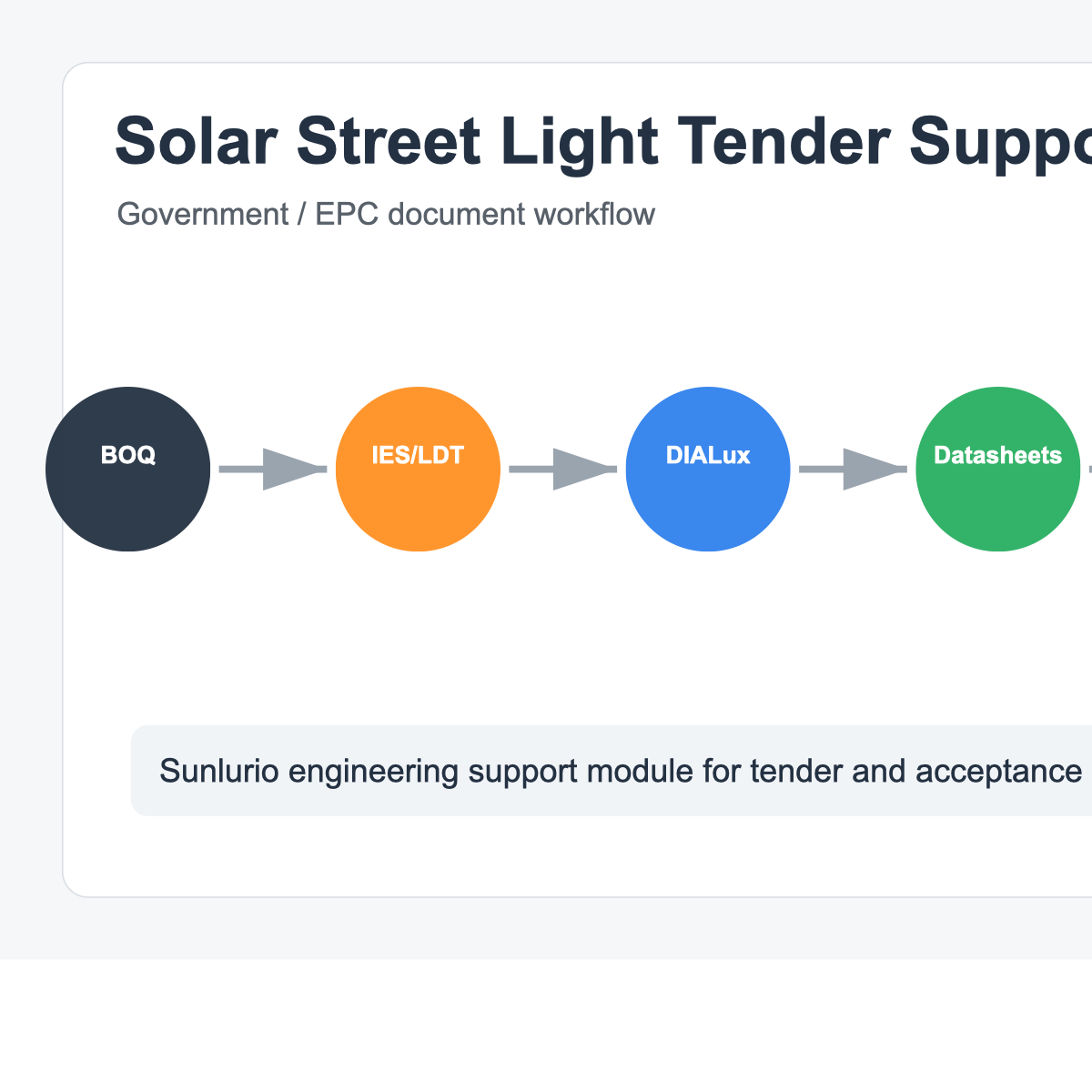
For related project preparation, you can request a DIALux lighting simulation, review the datasheets and drawings pack, compare all-in-one, all-in-two and split systems, or request a tender support pack.
Who This Page Is For
- Government and municipal procurement teams preparing a solar street light tender.
- EPC contractors matching a BOQ to real site conditions.
- Engineering consultants reviewing lighting layout, pole height, spacing, and compliance documents.
- UN / NGO or donor-funded project teams that need transparent documentation.
- Distributors and agents who need a document pack for local submission.
Project Situation
Most tender problems start before the supplier is selected. The project may have a target wattage, pole height, or budget, but may not yet include enough site data to confirm whether the proposed system can meet lighting and autonomy requirements.
For a government solar street lighting project, the technical discussion should normally include road type, pole spacing, installation height, required operating hours, rainy-season autonomy, lighting level target, local wind conditions, battery chemistry, solar panel capacity, and the documents needed for approval.
Common Project Risks
- The BOQ lists wattage but not lighting performance requirements.
- Pole spacing is copied from an old grid-connected project without DIALux verification.
- Battery autonomy is estimated for sunny weather only.
- IES files or LDT files are requested too late for layout checking.
- Datasheets do not match the exact configuration quoted.
- Pole, foundation, and bracket details are not reviewed before civil works.
- Certificates are listed in the tender but not matched to the actual product category.
- The quotation compares product prices without comparing document completeness.
Required Information Before Recommendation
A useful recommendation needs site and tender information first. Without these inputs, the supplier can only guess the system configuration.
| Information Required | Why It Matters | Example / Notes |
|---|---|---|
| Road or area type | Determines lighting class and pole arrangement | Main road, rural road, parking area, campus, port, perimeter |
| Pole height and spacing | Controls lighting uniformity and optic selection | Existing pole data or proposed layout |
| Required operating hours | Affects battery and dimming profile | Full power first hours, dimming after midnight, motion mode |
| Rainy-season autonomy | Determines battery and panel sizing | 2, 3, or 4 cloudy-day target depending on project risk |
| Installation location | Affects solar resource, wind, corrosion, and logistics | City/country, coastal or inland, high wind or normal |
| Tender document list | Defines what needs to be submitted | Datasheet, IES/LDT, DIALux, drawings, certificates, BOQ |
| Budget or BOQ format | Helps match configuration without over-specifying | Itemized BOQ or turnkey package |
Technical Document Checklist
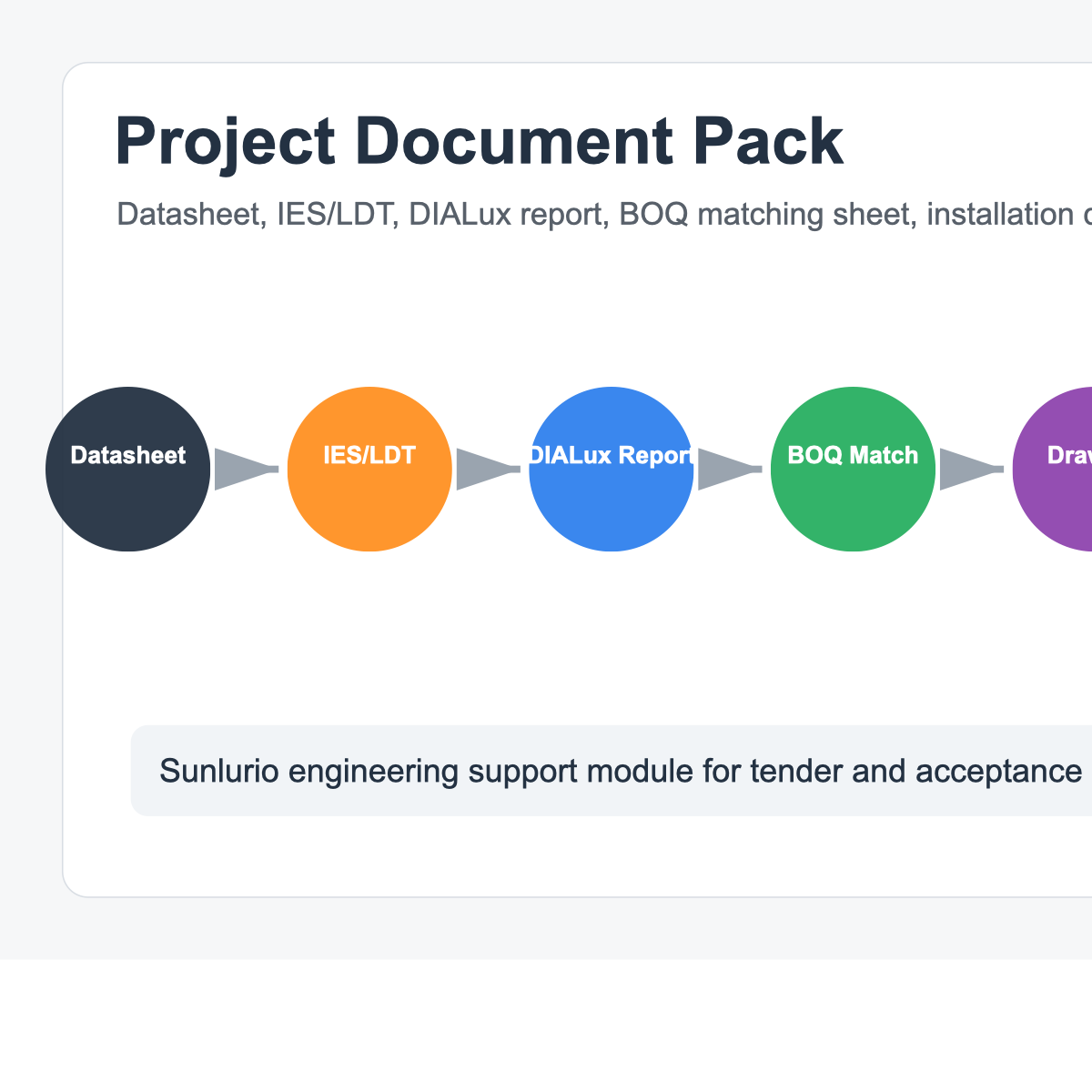
| Document | Purpose in Tender Review | When to Request |
|---|---|---|
| Product datasheet | Confirms product platform, power, battery, panel, optics, and controller information | Before technical comparison |
| IES / LDT files | Supports lighting layout and DIALux simulation | Before final pole spacing and optic decision |
| DIALux report | Shows lighting level, uniformity, pole spacing, and layout assumptions | Before tender submission or final technical review |
| BOQ matching sheet | Connects tender line items with proposed product configuration | During quotation review |
| Installation drawing | Supports civil, electrical, and site installation planning | Before procurement or site work |
| Pole and foundation information | Helps check structural and installation requirements | Before foundation work |
| Certificate or compliance documents | Supports tender eligibility and customs/project approval | Before submission, not after award |
| Acceptance checklist | Defines how the project will be inspected and handed over | Before shipment or installation planning |
Tender Document Checklist
| Tender Requirement | Supplier Document to Match | Review Question |
|---|---|---|
| Solar street light model | Datasheet and quotation | Does the model match the quoted battery, panel, and lamp power? |
| Lighting performance | IES/LDT file and DIALux report | Are pole spacing and road width based on the real site? |
| Battery autonomy | Configuration sheet | Is rainy-season autonomy stated clearly? |
| Pole height and foundation | Drawing or engineering note | Are pole, arm, anchor bolt, and foundation assumptions clear? |
| Warranty and maintenance | O&M note and warranty terms | Are battery, LED, controller, and spare parts handled separately? |
| Compliance documents | Certificates and test summaries | Are documents relevant to the actual tender requirement? |
Information Required Before Quotation
| Input From Buyer | Minimum Detail Needed | Risk If Missing |
|---|---|---|
| Project location | City/country or solar zone | Solar panel and battery may be undersized |
| Road width and pole spacing | Drawing, sketch, or existing site data | DIALux layout may not represent the project |
| Lighting standard target | Local standard or lux requirement | Supplier may quote by wattage only |
| Autonomy days | Required cloudy/rainy-day backup | Runtime claims become difficult to verify |
| Tender document format | BOQ, technical form, certificate list | Submission package may be incomplete |
| Installation responsibility | Supplier, EPC, or local contractor | Drawings and site checklist may be mismatched |
System Selection Matrix
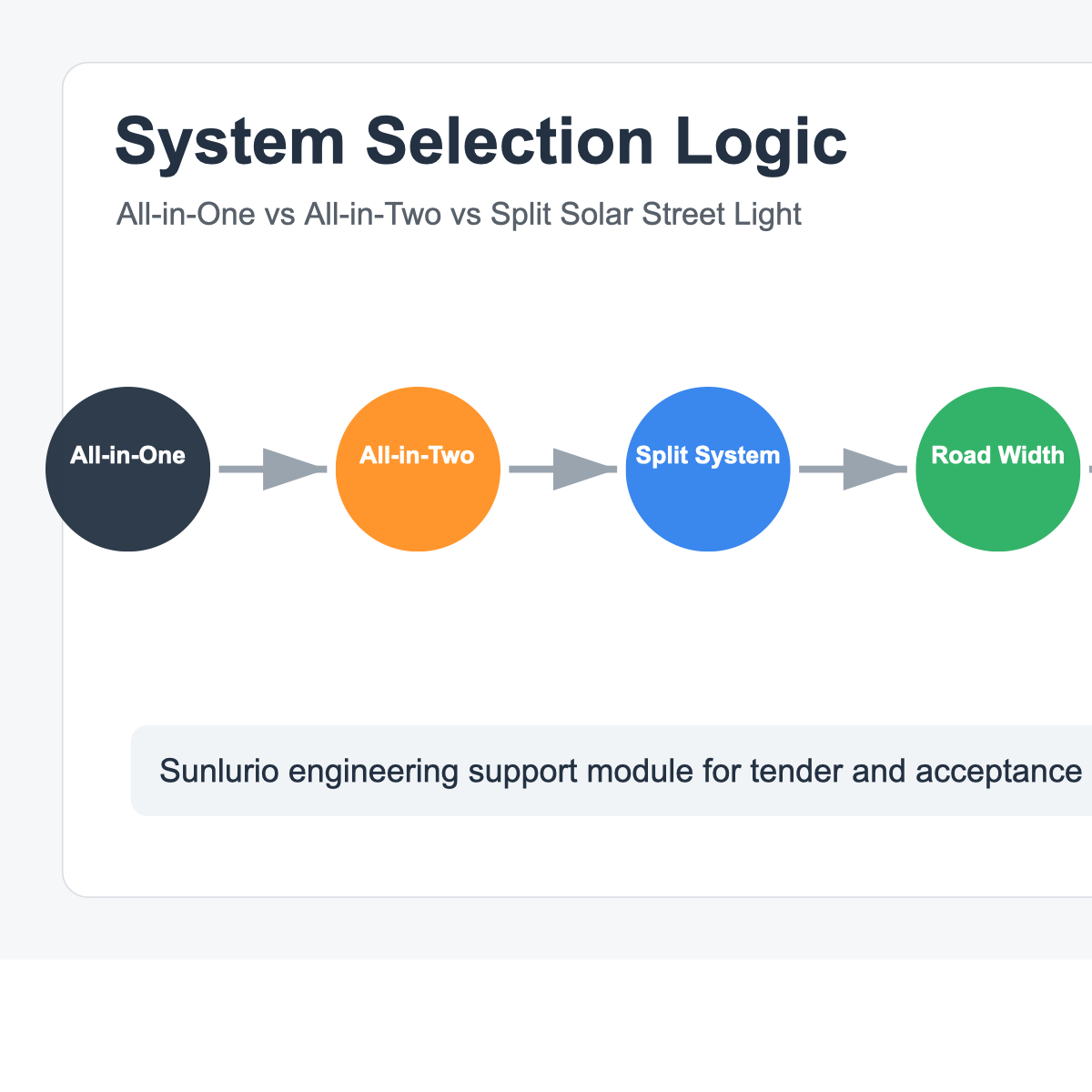
| Project Condition | Better Fit | Notes |
|---|---|---|
| Rural road with limited traffic | All-in-one or all-in-two system | Motion dimming may be useful if accepted by the project |
| Municipal road with stable lighting requirement | Split solar street light | Easier to size battery and panel for longer runtime |
| Coastal or high-corrosion area | Corrosion-resistant pole and fixture details | Review coating, fasteners, and enclosure protection |
| Wide road or strict uniformity target | Optic selection with DIALux support | Wattage alone is not enough |
| Tender requires detailed technical files | Supplier with document pack workflow | Datasheet, IES/LDT, drawings, BOQ matching, certificates |
Common Tender Risks and How to Avoid Them
| Risk | Why It Happens | How to Reduce It |
|---|---|---|
| Low price but incomplete documents | Supplier quotes product only | Request a full project document pack before final comparison |
| Poor lighting result after installation | Pole spacing and optic not simulated | Use IES/LDT files and DIALux layout before confirmation |
| Battery runtime complaints | Autonomy and dimming profile not reviewed | Ask for configuration logic and operating-hour assumptions |
| Installation delays | Drawings and foundation data arrive late | Request installation drawings before civil works |
| Tender rejection or clarification | Certificate list does not match tender wording | Review certificate purpose and scope early |
Engineering Notes
The best tender response is not always the highest wattage or the lowest price. It is the proposal that connects site data, lighting performance, autonomy, product configuration, and documents in a way that can be reviewed by a technical committee.
For engineering review, ask the supplier to explain the assumptions behind the configuration. A datasheet should match the quoted product. A DIALux report should use realistic pole spacing and road width. A BOQ should make it easy to compare system options without hiding battery, panel, pole, or document differences.
Sunlurio Project Support Workflow
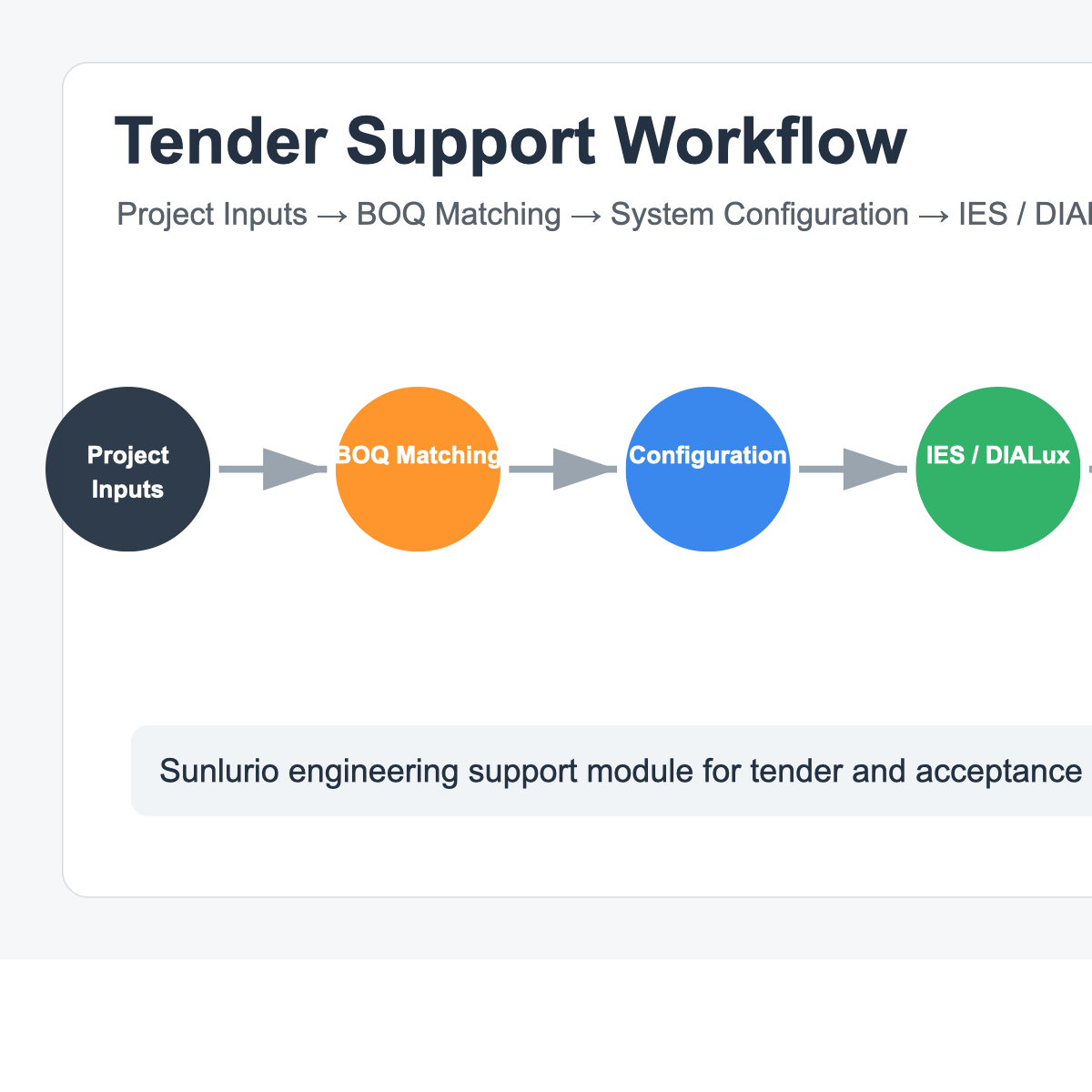
Sunlurio supports tender-focused solar street lighting projects through a document-first workflow:
- Confirm project inputs: location, road width, pole height, pole spacing, operating hours, autonomy target, and tender document list.
- Match BOQ and configuration: connect each BOQ line with the proposed lamp, solar panel, battery, controller, pole, bracket, and accessory configuration.
- Provide datasheets / IES / LDT / drawings: prepare documents that match the exact product platform and project assumptions.
- Support DIALux when applicable: use IES/LDT files and layout assumptions when road width, pole spacing, uniformity, or consultant review requires simulation.
- Review project document pack before quotation: check that datasheets, drawings, BOQ mapping notes, certificates, and support files match the tender requirement.
When DIALux / IES / BOQ Support Is Required
| Project Condition | Recommended Support | Reason |
|---|---|---|
| Wide road or strict uniformity target | DIALux + IES/LDT | Wattage alone cannot prove road coverage or uniformity. |
| Fixed pole spacing in tender | Simulation check | Existing spacing may not match the proposed fixture and optic. |
| BOQ lists wattage only | Configuration review | Battery, panel, controller, optics, and pole details still need matching. |
| Government / donor-funded project | Full document pack | Reviewers often need traceable datasheets, drawings, photometric files, and compliance documents. |
| Existing pole layout | IES matching and layout verification | The selected fixture should be checked against actual mounting height and spacing. |
FAQ
Do government tenders always need DIALux?
Not always, but DIALux is useful when the tender needs lighting level, uniformity, pole spacing, or optic verification. It is especially important for municipal roads, campuses, ports, and larger public projects.
Are IES files and LDT files the same thing?
Both are photometric file formats used for lighting simulation. The required format depends on the software and tender requirement. Many project teams request IES / LDT files together.
Is higher wattage always better for a solar street light tender?
No. Higher wattage increases battery and solar panel demand. The better question is whether the system meets the required lighting result and autonomy under real site conditions.
What should be included in a project document pack?
A practical pack should include datasheets, IES/LDT files, DIALux support if needed, drawings, BOQ matching notes, configuration assumptions, relevant certificates, and an acceptance checklist.
Should a tender compare all-in-one, all-in-two, and split systems?
If the project is still in early design, yes. For final procurement, the tender should define the system type clearly enough for fair comparison.
Request a Tender Support Pack
Send your project location, road width, pole height, spacing, working hours, backup days, BOQ format, and required tender documents. Sunlurio can help prepare configuration guidance, datasheets, IES/LDT files, DIALux support when applicable, drawings, and BOQ matching notes.