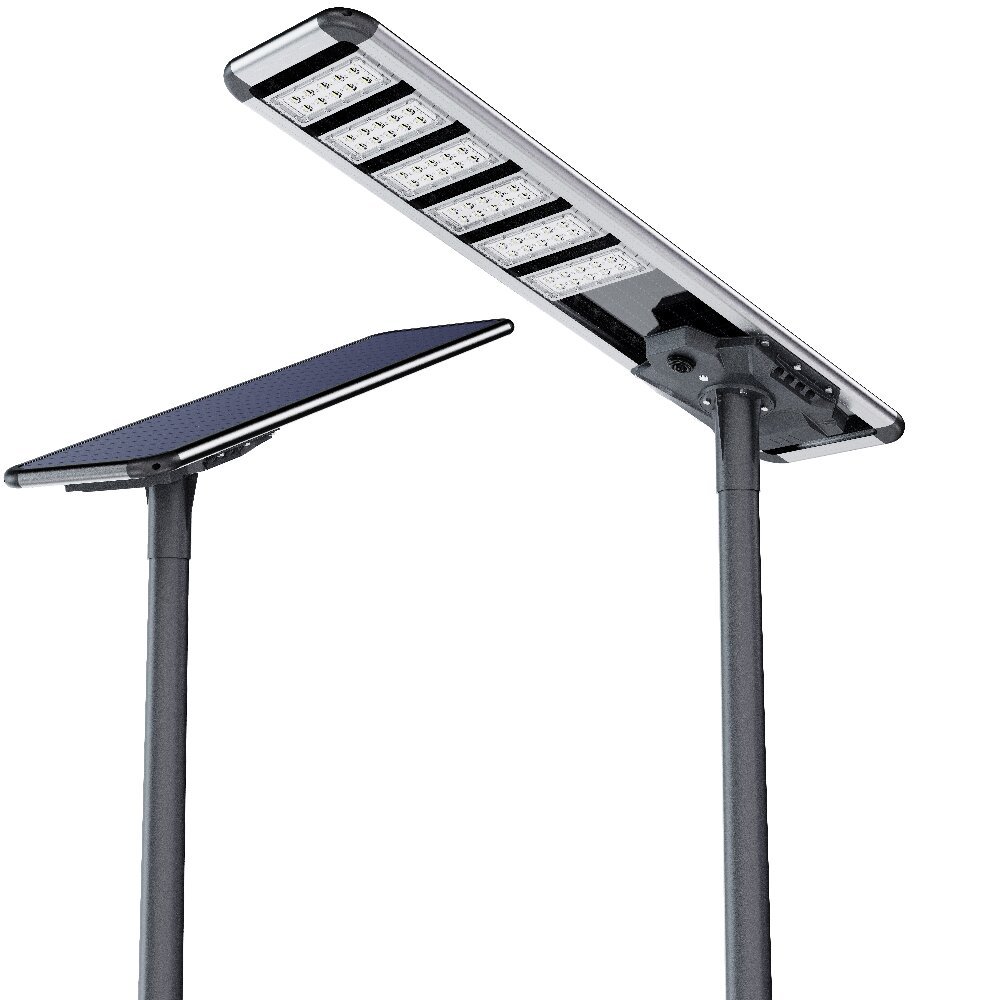
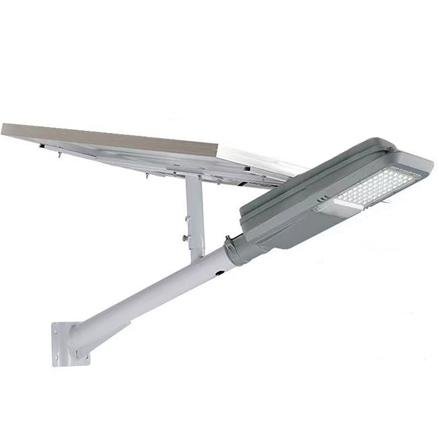
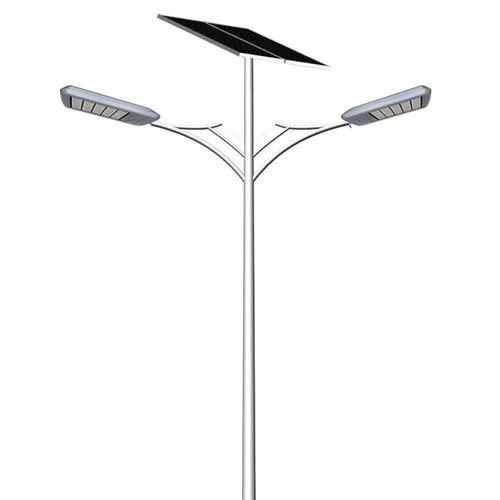
Scope of this engineering guide: 230 lm/W is a configuration-specific efficacy target or calculation input, not a verified rating for every Sunlurio light. Request a complete-luminaire test report that identifies the model, optical configuration, CCT, stabilized input power, lumen output, temperature, and laboratory. Illustrative comparisons below are not field measurements or a service-life guarantee.
1. Introduction
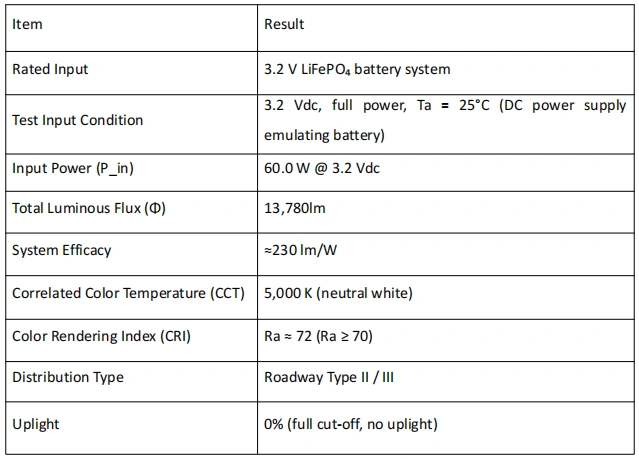
High-efficiency solar street lighting has moved from an experimental concept to a mature infrastructure solution. Progress in LED semiconductor physics, driver conversion efficiency, optical extraction and integrated solar energy systems now allows complete luminaires to operate at very high system efficacy levels.
The transition to 230 lm/W system-level efficacy is not just a new chip generation. It is the result of coordinated optimisation across the entire electromechanical chain of a solar lighting unit – from LED package and driver design to optics, thermal management and solar system integration. This white paper explains how system-level efficacy is engineered, how it is verified, and how high-efficacy systems are designed for reliability and long-term performance in African and Middle Eastern environments.
Unlike chip-level or module-level claims, system-level efficacy includes real-world losses such as thermal droop, driver conversion inefficiency, optical transmission losses, lens absorption, spectral shifts and environmental operating conditions. Understanding this internal engineering is essential for governments, EPC contractors, consultants and project owners who must evaluate 230 lm/W claims for long-term public lighting projects.
1.1 Why 230 lm/W Really Matters (and How to Verify It)
This guide uses 230 lm/W as a hypothetical complete-luminaire calculation input, not as a verified rating for a Sunlurio product. LED chip efficacy and complete-luminaire efficacy are different measurements. For procurement, use a full-luminaire report matching the offered model, optic, CCT, input power and test conditions.
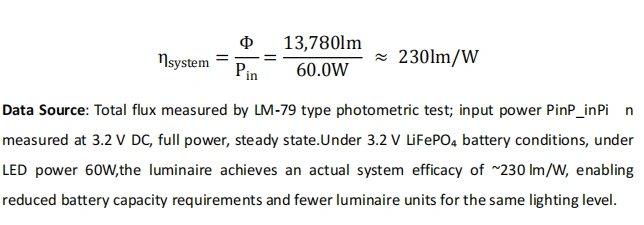
For project teams, the key question is simple: is the claimed 230 lm/W real at luminaire level? This can be checked using two values from an LM-79 report or a full-luminaire photometric test:
- Total luminous flux of the luminaire: Φout (in lumens, lm)
- Input power of the luminaire: Pin (in watts, W)
The system efficacy is:
ηsystem = Φout / Pin
For example, if a solar street light shows a measured total luminous flux of 13,800 lm and a steady-state input power of 60.0 W, then:
13,800 lm ÷ 60.0 W = 230 lm/W
This value already includes losses from the LED package, the driver, the optical lens, the diffuser and the housing. It is a practical, system-level number that EPCs and buyers can evaluate directly from the test reports. Sunlurio can provide sample LM-79 style data, IES files and key photometric excerpts for engineering review when required.
Quick check for EPC and tender engineers: when a supplier claims 230 lm/W, the first step is to request the full luminaire photometric report and confirm that the ratio of total lumens to steady-state input power reaches the claimed level under realistic test conditions.
2. Technical Foundations of 230 lm/W System-Level Efficacy
Achieving 230 lm/W at the system level is the result of many small efficiency gains along the chain, not a single breakthrough component. In practice, four technical domains must be engineered together: (1) LED package architecture, (2) driver and power-conversion design, (3) optical system efficiency, and (4) thermal management and junction temperature stabilisation. System efficacy is expressed as:
ηsystem = Φout / Pin
Where Φout is the luminous flux emitted from the luminaire after all optical losses, and Pin is the steady-state input power drawn at the terminals under full load. Achieving 230 lm/W typically requires that each upstream stage – LED, driver, optics and thermal design – operates with carefully controlled losses. The following subsections describe these mechanisms in an engineering-oriented way.
2.1 LED Semiconductor and Package Architecture
Modern high-efficacy road lighting is based on InGaN blue LED emitters combined with advanced phosphor-conversion layers. For a system to reach 230 lm/W at luminaire level, the LED packages themselves must be in the 250–280 lm/W class at device level under nominal drive current and case temperature. This is achieved through:
- Low-defect GaN epitaxy to increase internal quantum efficiency (IQE) and reduce non-radiative recombination.
- Optimised chip architecture such as thin-film flip-chip designs that lower internal reflection and series resistance.
- Narrow-band phosphors with high quantum-conversion efficiency and reduced Stokes loss for the chosen CCT.
- High extraction efficiency packaging using silicone or other optics with transmittance typically above 95%.
- Operation at controlled junction temperature to limit thermal droop and maintain lumen output over time.
A high-efficacy design may use selected 5050 LED packages at appropriate drive currents to reduce current droop. Confirm the actual package, supplier, current, and test basis for the offered Sunlurio model; this is not a specification covering every luminaire. These package-level choices form the base layer of the overall system-efficacy target.
2.2 Driver Electronics and Conversion Efficiency
Driver efficiency is a common bottleneck in otherwise efficient systems. Many commodity drivers for street lighting operate at around 88–90% efficiency in real installations, especially at partial load or elevated temperature. To support 230 lm/W system efficacy, driver design must minimise these losses.
Key design aspects include:
- High-efficiency topologies (for example, LLC-type resonant or other optimised architectures) to reduce switching and conduction losses.
- Carefully selected MOSFETs and magnetics that maintain efficiency across the expected input range and dimming levels.
- Low-ripple constant-current architecture to stabilise LED forward current and junction temperature.
- Optimised control algorithms for dimming, start-up and protection that avoid unnecessary stress and loss.
For a proposed high-efficacy luminaire, request driver test data at the designed operating point. >92% efficiency is a design example here, not a universal verified product rating; THD and power factor apply to the relevant AC input configuration. A seemingly small drop of 3–5% in driver efficiency can easily reduce system efficacy by 8–10 lm/W, so driver selection and validation are treated as a critical engineering step.
2.3 Optical Efficiency and Light Extraction
Optical losses account for a significant part of the gap between LED package efficacy and system-level lm/W. Achieving 230 lm/W at luminaire level requires that the optical train – lenses, covers and housing geometry – maintains high transmission while shaping the beam correctly for the road.
Important factors include:
- PMMA or PC lenses with high transmission (typically >92%) over the relevant wavelength range.
- Precision-moulded Type II / Type III optics that direct light to the target zones with minimal spill or backlight loss.
- Anti-yellowing formulations and UV-stable materials to limit long-term degradation of optical output.
- Full or near full cut-off geometries that eliminate uplight and improve effective luminaire efficiency on the road surface.
Because solar street lighting must deliver high road uniformity with limited available power, optical control is as critical as absolute lumen output. Sunlurio uses roadway optics that are designed and validated with photometric simulations so that the lm/W measured in the lab translates into usable lux on the carriageway.
2.4 Thermal Management and Junction Stability
Maintaining LED junction temperature at an acceptable level is essential for both lm/W and lifetime. Above approximately 85°C junction temperature, many LED packages experience thermal droop that can reduce luminous efficacy by 10–20% and accelerate lumen depreciation.
High-efficacy systems therefore rely on:
- Die-cast or extruded aluminium heat sinks engineered with airflow channels for natural convection.
- Low-thermal-resistance substrates such as aluminium MCPCBs with low Rθ between junction and case.
- Thermal spreading elements to distribute heat away from local hot spots.
- Simulation-driven thermal design using CFD and FEA to verify performance before tooling.
Thermal suitability for an African or Middle Eastern site must be checked against the offered configuration and local maximum temperatures. Request the thermal test conditions and applicable lumen-maintenance basis; laboratory efficacy and package L90/L80 projections alone do not establish complete field-system life.
2.5 230 lm/W vs 160–180 lm/W: Practical Impact on Power and Sizing
To understand the benefit of 230 lm/W, it is useful to compare it with a typical 160 lm/W system for the same road brightness. Assume a roadway needs an illustrative 6,400 lm per luminaire. This assumed flux does not itself establish compliance with a lighting class.
| Item | Conventional street light | High-efficacy system (230 lm/W) |
|---|---|---|
| Target luminous flux | 6,400 lm | 6,400 lm |
| System efficacy | 160 lm/W | 230 lm/W |
| Required system power | 40 W | ≈ 28 W |
| Power saving | – | about 30% reduction |
| 12 h energy consumption per night | ≈ 480 Wh | ≈ 334 Wh |
| Solar panel & battery sizing | 100% reference size | 70% load-energy ratio in this simplified example; recalculate installed capacity |
With the same road brightness, a 230 lm/W system can reduce power and daily energy consumption by around 30% at luminaire level in this simplified example. For solar street lighting, a lower lighting load can support different PV and battery sizing. Do not reduce installed capacity automatically by 30%: recalculate the nightly profile, controller and wiring losses, design-month irradiance, usable depth of discharge, temperature derating, aging allowance, and autonomy margin; verify site lighting criteria separately. The exact percentages will depend on road class, location and design autonomy days, but the underlying relationship is consistent.
2.6 Why Many Products Stay at 160–180 lm/W
Many solar and grid street lights on the market remain at 160–180 lm/W system efficacy due to several technical constraints:
- LED package choice – use of older mid-power LEDs or operation at high current, which causes current droop and lower lm/W.
- Driver efficiency – low-cost drivers with 85–88% efficiency, particularly at dimmed or partial power levels.
- Optical design – simple lenses with higher optical loss, limited control of the beam and more spill light.
- Thermal design – insufficient heat sinking, leading to high junction temperature and stronger thermal droop.
Sunlurio designs around these bottlenecks by:
- specifying high-efficacy 5050 LED packages operated at optimised drive currents;
- using driver platforms that are validated to maintain high efficiency at the real operating point;
- applying roadway lenses with controlled beam patterns and low optical loss;
- optimising thermal paths so that junction temperature stays within the design window in hot climates.
A 230 lm/W luminaire-level claim must be supported by a full-luminaire report matching the model, input power, optic, CCT, and operating conditions. LED chip data alone cannot verify it.
3. Verification and Testing Framework for High-Efficiency Systems
High-efficiency systems must be validated through a structured test methodology. A credible verification framework covers photometric, electrical, thermal and environmental performance, and links lab measurements to expected field behaviour. For EPC contractors and public buyers, this framework also defines which documents to request from suppliers.
3.1 Photometric Measurement and Performance Validation
Accurate measurement of system efficacy requires:
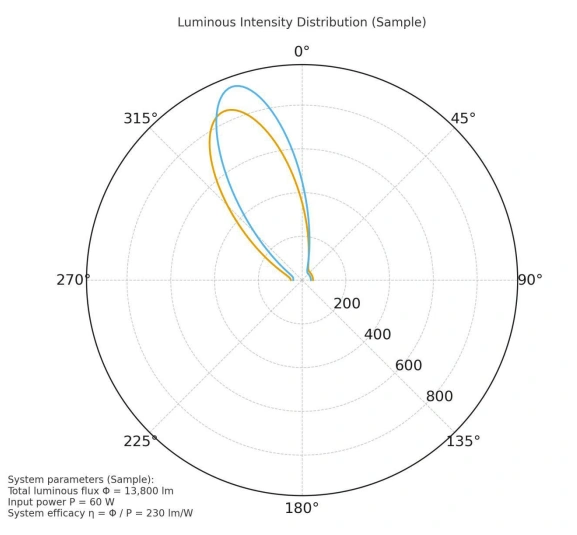
- Full luminaire photometry using integrating spheres or goniophotometer systems to measure total lumens and intensity distribution.
- Steady-state electrical input measurement once the luminaire has reached thermal equilibrium.
- Spectral analysis to validate CCT, CRI and chromaticity coordinates.
- Optical distribution mapping to confirm Type II / Type III roadway patterns and cut-off characteristics.
Measurements must be conducted after thermal stabilisation to avoid transient fluctuations. Sunlurio uses full-luminaire photometric reports (LM-79 style) and provides IES files and key data summaries so that design engineers can perform their own simulations and checks.
3.2 Electrical and Conversion Efficiency Testing
To validate driver performance in high-efficacy luminaires, the following parameters are measured:
- Steady-state input/output power ratio (driver efficiency).
- Efficiency across different dimming levels that will be used in the field.
- Total harmonic distortion (THD) and power factor (PF) for grid-connected systems.
- Ripple current and LED forward current stability over temperature.
These measurements confirm that the driver supports the target lm/W in real operating conditions, not only at a single ideal point in the lab.
3.3 Thermal Stress and Reliability Testing
Long-term reliability and lm/W stability are evaluated using:
- Temperature-humidity bias tests (for example, 85°C / 85% RH) on critical sub-assemblies.
- Thermal cycling (e.g. -20°C to +60°C) to simulate daily and seasonal temperature swings.
- Heat-soak testing to reproduce desert mid-day thermal loads on the luminaire and battery compartment.
- Junction temperature tracking with thermocouples and IR imaging during operation.
The goal is to confirm that the luminaire maintains high output and does not suffer from unexpected failures or rapid lumen loss under harsh environmental conditions.
3.4 Environmental and Mechanical Testing
For outdoor road and area lighting, mechanical and environmental robustness is as important as lm/W:
- Ingress protection: IP66 validation for dust and water ingress.
- Impact resistance: IK08 or higher for the luminaire enclosure.
- Salt-spray resistance for coastal deployments and ports.
- UV exposure testing for lenses, gaskets and housing coatings.
These tests verify suitability for African coastal regions, Middle Eastern desert zones and humid equatorial climates where many solar lighting projects are deployed.
3.5 Checklist for EPC and Tender Engineers
When evaluating 230 lm/W claims for road or solar street lighting projects, EPCs and public buyers can request:
- Full luminaire photometric report (LM-79 style) with total lumens and input power clearly stated.
- Driver efficiency and electrical test data at the proposed operating point and dimming profile.
- Summary of thermal tests and typical junction temperature in representative ambient conditions.
- Environmental and mechanical test reports (IP, IK, salt-spray, UV exposure where applicable).
This documentation set allows project teams to verify whether a proposed 230 lm/W system is technically credible and suitable for long-term infrastructure use.
4. System-Level Design for Solar Integration
High lm/W at luminaire level is only one part of a solar street lighting system. Long-term performance also depends on correct solar system design: energy balance calculations, battery sizing models, charge controller strategy and seasonal irradiance analysis. High-efficacy luminaires reduce the energy demand side of this equation, enabling more compact and robust solar systems.
4.1 Energy Balance and Autonomy Calculation
The core design equation for the daily lighting load is:
Edaily-load = Pluminaire × tlighting
Where Pluminaire is the average power during the lighting period and tlighting is the total number of hours per night. A high-efficiency luminaire directly reduces this value, enabling:
- smaller PV modules to produce the required Wh/day,
- smaller battery capacity for the same design autonomy,
- lower structural weight and bill-of-materials (BOM) cost.
4.2 PV and Battery Sizing Methodology
Sizing the PV and battery requires matching daily energy generation to consumption with suitable safety margins. Engineers consider:
- solar irradiance in the specific region (kWh/m²/day),
- seasonal minimum insolation and worst-month conditions,
- panel derating due to dirt, high temperature and ageing,
- battery depth-of-discharge limits and cycle life targets.
Higher verified luminaire efficacy may reduce the nightly lighting load. Any reduction in PV or battery capacity requires a new energy balance using the dimming profile, worst-month solar resource, electrical losses, temperature, usable battery capacity, aging and autonomy margin. Illustrative efficacy values alone do not justify a smaller installed system.
4.3 Charge Controller Optimisation
Maximum Power Point Tracking (MPPT) charge controllers offer important advantages over simpler PWM designs:
- higher daily energy harvest, especially in variable irradiance conditions,
- better performance in low-light and cloudy periods,
- more controlled charging profiles that reduce battery stress.
In high-efficacy systems, MPPT controllers help ensure that the smaller PV array still provides enough energy to support the desired autonomy days, particularly during the worst solar months.
4.4 Battery Chemistry and Lifetime Modelling
LiFePO4 is widely used in modern solar street lighting systems because it offers:
- good thermal stability at elevated ambient temperatures,
- long cycle life when used within an appropriate depth-of-discharge range,
- high charge acceptance, which matches well with MPPT-based charging strategies.
Higher system-level efficiency reduces the required daily depth-of-discharge for the same lighting profile. This directly supports longer battery life and more stable performance over many years of operation.
4.5 Project Data Required for 230 lm/W Solar Design
To design a realistic 230 lm/W solar street lighting system, engineers typically require:
- road type, width and target lighting class,
- pole height, spacing and mounting arrangement,
- location (city, country) and any available solar irradiance data,
- required autonomy days and backup strategy,
- whether the project is new build or retrofit of existing poles.
Providing this information together with any existing BOQ or drawings allows a realistic evaluation of whether a 230 lm/W-based system can reduce PV and battery sizing while maintaining the required lighting performance.
5. Roadway Optical Engineering and Deployment Methodology
High-efficiency systems must not only produce high lumen output; they must also distribute light effectively and safely on the road. Roadway lighting performance depends on optical pattern design, pole layout, mounting height and the reflective properties of the pavement.
5.1 Optical Distribution and Illuminance Modelling
Type II and Type III optics are commonly used for local roads, collectors and some highway applications. They provide optimised longitudinal and transverse distribution for road widths of roughly 6–14 metres. These optic types:
- minimise spill light outside the carriageway,
- support good longitudinal and transverse uniformity,
- improve visual comfort and reduce glare for drivers and pedestrians.
With 230 lm/W luminaires, precise optic design ensures that the additional lm/W translates into better coverage or wider pole spacing, rather than wasted light.
5.2 Pole Height and Spacing Optimisation
Higher efficacy alone does not justify wider pole spacing or fewer poles. Verify the proposed layout using model-matched photometry and the required lighting class. When designing layouts, engineers consider:
- target average illuminance or luminance,
- uniformity ratio (Emin / Eavg or Lmin / Lavg),
- road width, number of lanes and median configuration,
- mounting height, overhang and luminaire tilt angle.
Use DIALux or equivalent lighting calculations to compare pole height, spacing and optics with the offered luminaire’s IES/LDT file. Retain the required maintained illuminance or luminance, uniformity and glare criteria. Efficacy alone does not establish compliant spacing or pole count.
5.3 Real-World Performance and Degradation Factors
Real-world performance over years of operation is influenced by:
- lumen depreciation of LEDs (L90, L80 curves) at the actual operating temperature,
- lens yellowing or transmission loss due to UV exposure and ageing,
- dust and dirt accumulation on panels and lenses, which can reduce illuminance by 5–20% if not cleaned,
- thermal derating during periods of very high ambient temperature.
When evaluating 230 lm/W claims, the key is not only the initial lm/W but how much of that performance can be retained in year 3, 5 or 8 under local maintenance and climate conditions. Designs that combine high initial efficacy with strong control of these degradation mechanisms deliver the best lifetime value.
6. Conclusion
The 230 lm/W calculations in this guide illustrate how efficacy affects lighting energy demand; they are not a product test report. Evaluate the offered LED package, driver, optics and thermal design using configuration-matched evidence. Solar energy balance and site lighting performance require separate calculations for the intended climate and operating profile.
For governments, consultants and EPC contractors, understanding the technical basis of 230 lm/W systems enables more informed procurement decisions, better risk control in tenders and improved long-term sustainability of public lighting infrastructure. Evaluating full-luminaire photometric data, driver efficiency, thermal performance and environmental test results is essential when comparing suppliers.
For a proposed Sunlurio system, review the evidence for the selected high-efficacy luminaire, LiFePO4 battery pack, and optional IoT controller. Efficacy, battery life, and communication features depend on the offered configuration. In real projects, this combination helps reduce system size and energy use while supporting smarter, more resilient lighting networks for roads and public spaces.
Review the lumen maintenance and maintenance-factor guide, 3.2V current and protection analysis, and tender evidence checklist before fixing project requirements.