Smart Street Lighting Solutions

Controller-ready architecture with monitoring, fault alerts, and acceptance logic—built for multi-site deployments.

Best Fit / Not a Fit

Best Fit
  • Multi-site streets requiring centralized monitoring and visibility.
  • Projects needing fault alerts, event logs, or energy reporting.
  • Deployments where O&M teams need actionable maintenance triggers.
Not A Fit
  • Single site with no monitoring or control requirement.
  • No defined control boundary (controller scope / comms plan unknown).
  • Acceptance criteria and O&M workflow are undefined.

Typical Solution Package

Base Package
Remote visibility + location + savings
  • Remote monitoring: Live status, on/off confirmation, and fault alerts so you know which lights need attention before dispatch.
  • GPS asset location: Each light can be mapped by pole/location for faster maintenance and clearer asset tracking across sites.
  • Energy & runtime control: Schedule and dimming logic aligned with operating hours to reduce waste when full output is not required.
  • Maintenance reduction: Fewer unnecessary site visits by diagnosing issues remotely and dispatching only when needed.
Outcome
Lower O&M cost through remote visibility, faster troubleshooting, and location-based asset management.
Scenario Options
Customized by requirement
  • Monitoring depth: Basic status only / plus alerts / plus performance history (by your O&M needs).
  • GPS & mapping: Site map grouping (site → zone → pole) for fast navigation and maintenance routing.
  • Control logic: On/off + scheduling / plus dimming profiles / plus adaptive rules (as required).
  • Reporting: Energy and runtime summaries for multi-site oversight and budget planning.
Customization Rule
Define the O&M goal first (visibility / location / savings / reporting), then finalize the control scope and monitoring level.
Engineering Support (When Required)
Boundary + acceptance logic
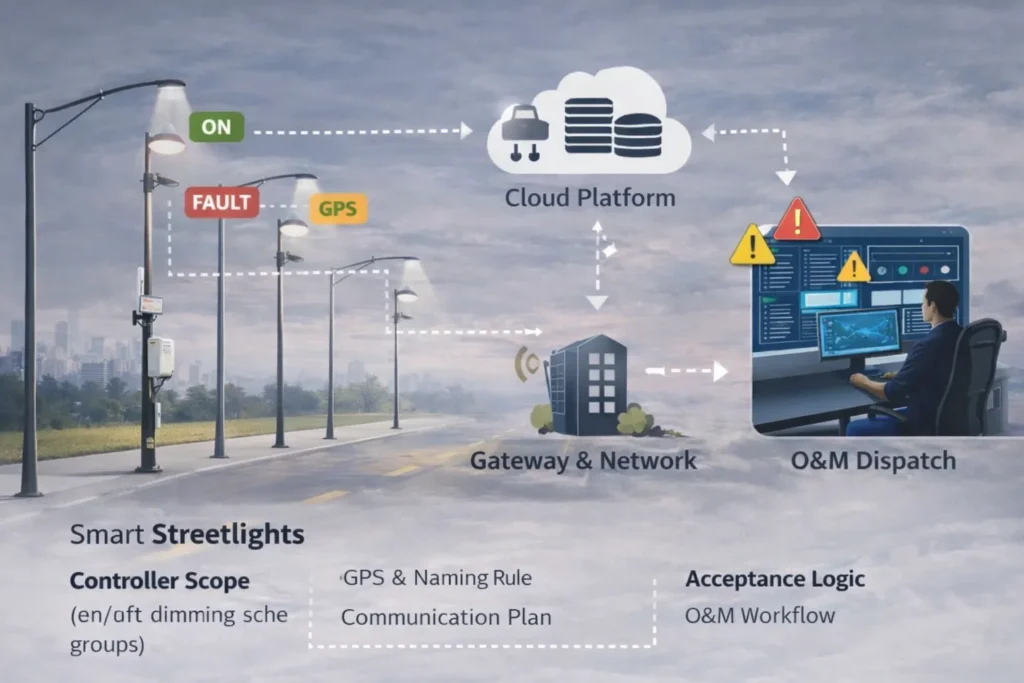
  • Scope confirmation: Confirm controller scope, communication plan, and monitoring depth before rollout.
  • Grouping & naming: Agree on site/zone/pole naming rules to keep dispatch and reporting consistent.
  • Acceptance criteria: Define pass/fail checks (connectivity, reporting, alert behavior) for commissioning and handover.
Deployment Boundary
The system should be finalized only after the monitoring scope and acceptance logic are confirmed to avoid rework after installation.

Assumptions to Confirm Before Rollout

Smart deployments depend on a clear control boundary, communication plan, and acceptance criteria. Missing inputs will be stated as assumptions.
Control & System Inputs
  • Controller scope (on/off, dimming, schedules, groups)
  • GPS / asset identity (site → zone → pole naming rule)
  • Monitoring scope (status, faults, runtime, energy)
  • Offline behavior (what happens when comms drops)
  • Data interval (reporting frequency / event logs)
Acceptance & O&M Boundary
  • Acceptance criteria (pass/fail checks after commissioning)
  • Alert rules (which faults trigger dispatch, escalation timing)
  • Response workflow (who receives alerts, SLA expectation)
  • Security boundary (access roles, credentials, ownership)
  • Integration boundary (platform/API requirement, if any)
Minimum required to start: controller scope, communication plan, naming/grouping rule, acceptance criteria, and alert workflow.
Smart street lighting system architecture diagram showing controllers, network gateway, cloud platform, and monitoring dashboard

Options by Deployment Priorities

01
Cost-Controlled Smart Rollout
  • Keep the control scope minimal (on/off + basic schedules, dimming only if required).
  • Use a simple grouping rule (site → zone → pole) to reduce setup and training cost.
  • Avoid custom integrations and “nice-to-have” dashboards unless they change O&M outcomes.
02
Acceptance & Audit-Ready Deployment
  • Define acceptance criteria (connectivity, reporting, alert behavior) before commissioning.
  • Set traceable rules: controller scope → grouping → alerts → reporting (no silent defaults).
  • Clarify ownership and access roles (who manages credentials, data, and escalation).
03
Maintenance-First Operations
  • Prioritize actionable alerts (dispatch triggers) over “more data” to avoid alarm fatigue.
  • Define offline behavior so lights remain predictable when communication drops.
  • Align alert escalation with real response capacity (who responds, when, and how).

Proof & Due Diligence

See deployment scenarios and configuration sanity checks.
QC workflow, test capability, and traceability approach.

Contact Engineering Team

Share constraints and receive a solution-ready response.

Markets & Deployment Conditions

Typical constraints by region—coastal, hot, dusty, and heavy-rain environments.

Common Questions Before Commissioning

How do I choose the right smart lighting scenario for my project?
Start with your operational goal: remote visibility, fault alerts, energy reporting, or multi-site control. Then confirm the control boundary (on/off, schedules, dimming), communication plan, and how assets will be grouped (site → zone → pole). With these inputs, we can recommend a scenario-ready package aligned with your rollout and O&M workflow.
What information should I prepare before requesting a recommendation?
At minimum: controller scope (on/off, schedules, dimming if needed), communication method (cellular / gateway / offline mode), grouping rule (site → zone → pole), monitoring scope (status, faults, runtime, energy), and acceptance criteria (pass/fail checks after commissioning). If you already have an O&M escalation workflow, include it for faster alignment.
Remote monitoring vs. smart control — what’s the practical difference?
Remote monitoring focuses on visibility: you can see status, faults, and performance history. Smart control adds action: schedules, dimming profiles, grouping, and operational rules. Many projects start with monitoring + basic schedules, then expand control scope only when the O&M team is ready to operate it.
Do I need GPS for every light pole?
GPS is most valuable when you manage many poles across multiple sites and need location-based maintenance routing and asset tracking. If the site is small or already has a clear pole map, you may use a simplified location method. For multi-site rollouts, GPS (or a reliable location ID) significantly reduces dispatch time and reporting confusion.
What happens if communication drops — will the lights stop working?
They should not stop. A proper smart deployment defines offline behavior in advance: the lights follow the last known schedule or a safe default mode until communication resumes. This keeps operation predictable and avoids field confusion. Offline rules should be part of acceptance criteria.
What is the typical process after I pick a smart scenario?
You confirm the control boundary, communication plan, grouping rule, monitoring scope, and acceptance criteria. Then we align alert rules and the O&M escalation workflow. After commissioning, the system is verified against pass/fail checks (connectivity, reporting, and alert behavior) before handover.

Rated Products

Smart Street Light

Smart Street Light

Smart Street Light

Smart Street Light

Download Catalog

Inside the Catalog:

  • Detailed product listings with high-resolution images
  • Technical specifications and customization options
  • Case studies and project examples
  • Competitive pricing information

Download our comprehensive catalog to explore our wide range of street lights and solar street lights, designed to meet the highest standards of quality and efficiency.


Request Your Custom Quote – No Middlemen

Request Your Custom Quote – No Middlemen

Request Your Custom Quote – No Middlemen

Request Your Custom Quote – No Middlemen