
IES/LDT Files Explained: What EPC Teams Should Request and How to Verify
IES/LDT files are plain-text “light distribution fingerprints” for a luminaire—used by lighting software to predict lux, uniformity, and sometimes glare risk. If you’re an EPC
 Skip to content
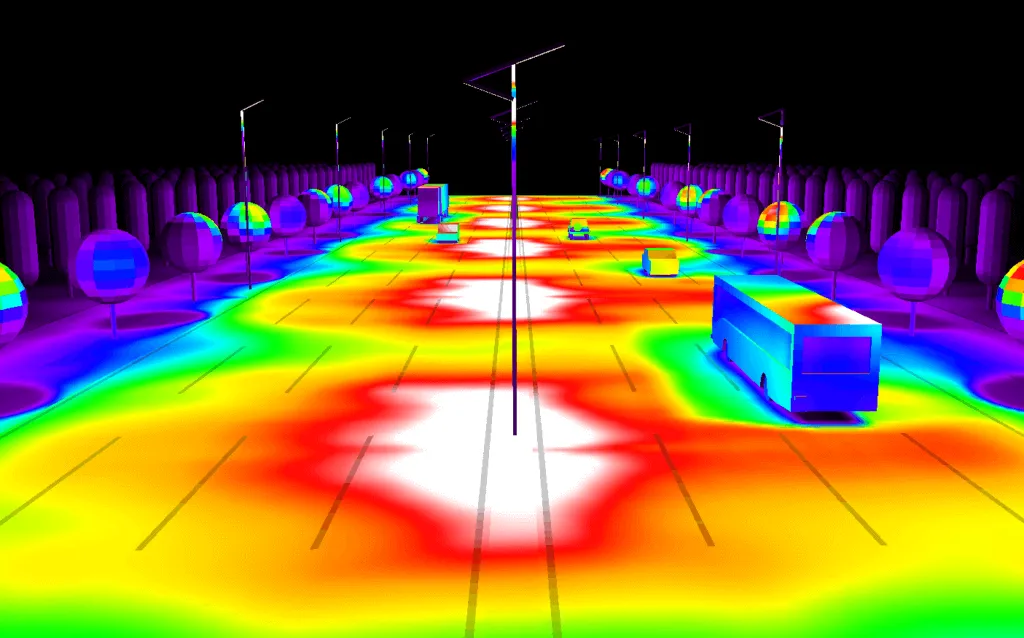
Lighting simulation is the bridge between design intent and real-world performance. Before any luminaire is installed, simulation tools such as DIALux EVO or AGi32 can accurately predict how light will distribute across roads, parking areas, plazas, and sports fields. A professional simulation ensures your project meets international standards, avoids overlighting, and achieves both safety and efficiency.
At Sunlurio, we use advanced photometric data (IES / LDT files), precise 3D site modeling, and realistic surface reflectance values to visualize every detail — from uniformity on roadways to spill-light control near residential areas. The result: a design that performs as beautifully as it looks on paper.
| Application | Standard | Average Lux | Uniformity (Min/Avg) | Threshold Increment (TI) |
|---|---|---|---|---|
| Urban Road (ME3a) | EN 13201 | 15 lx | ≥0.40 | ≤10% |
| Residential Street (S2) | EN 13201 | 7.5 lx | ≥0.40 | ≤15% |
| Parking Lot | IES RP-8 | 10–20 lx | ≥0.25 | ≤20% |
| Pedestrian Walkway | IES RP-33 | 5–10 lx | ≥0.25 | — |
| High Mast Area | EN 12193 | 30–50 lx | ≥0.50 | ≤10% |
Lighting simulation outputs include several maps and charts that guide design optimization:

Maintenance Factor (MF): typically 0.75–0.85.
MF = LLMF × LSF × LMF × RSMF, where:
LLMF = Lamp Lumen Maintenance Factor, LSF = Lamp Survival Factor, LMF = Luminaire Maintenance Factor, RSMF = Room Surface Maintenance Factor.
Road Width Ratio (RWR): RWR = Road Width / Mounting Height.
Design range: 1.2–1.8 for urban roads, 0.8–1.3 for residential streets.
| Region | Standard | Average Lux | Uniformity | Glare Index |
|---|---|---|---|---|
| EU | EN 13201 ME3a | 15 lx | ≥0.40 | TI ≤10% |
| US | IES RP-8 Collector Road | 13 lx | ≥0.35 | Veiling ≤0.3 |
| China | GB/T 9468-2008 A2 | 20 lx | ≥0.35 | GR ≤45 |
According to Sunlurio field audits (2024–2025), DIALux EVO predictions differ by less than ±8% from measured results when input photometry and surface reflectances are accurate. This validation ensures that simulation-based design remains a reliable engineering basis for government tenders and EPC projects.
Project: 8 m solar street lights for a residential community, East Africa.
Setup: 40 W LED @ 8 m height, Type II optic, 25 m spacing, 3000 K.
Result: Avg 8.6 lx, Min 2.8 lx, Uniformity 0.33, TI = 11%, compliant with EN 13201 S2.
Energy savings: 100% off-grid operation, MPPT controller, LiFePO₄ battery.
Conclusion: Optimized with 6° tilt and single-arm layout for improved uniformity across pavement center.
Written by the Sunlurio Lighting Engineering Team — specialists in outdoor and solar lighting design. We provide full DIALux EVO simulations, IES files, mounting layouts, and energy reports to ensure every project meets international standards. For custom lighting simulations, send us your drawings and parameters — we’ll help you visualize light before it touches the ground.

IES/LDT files are plain-text “light distribution fingerprints” for a luminaire—used by lighting software to predict lux, uniformity, and sometimes glare risk. If you’re an EPC
There is no single “best” solar street light manufacturer. The right choice depends on your road class, required autonomy nights, and—most importantly—the supplier’s ability to

For most roadway lighting projects, SMD luminaires are preferred because they offer more flexible optical distributions and simpler maintenance. COB can be a strong option
 Optimized by Seraphinite Accelerator