


Smart 4G / 5G Solar Street Lighting System
Integrated Communication Architecture & Key Advantages
2025 Prepared by: Sunlurio Engineering Team
1. System Overview
A smart 4G / 5G solar street lighting system is not simply a street light with a SIM card.
It is a complete infrastructure-level solution integrating:
- Solar power generation
- Energy storage and intelligent control
- High-efficiency LED lighting
- Multi-network cellular communication (3G / 4G / 5G)
- Cloud-based monitoring and asset management
The objective is long-term, stable operation in real-world environments, not short-term demonstration performance.
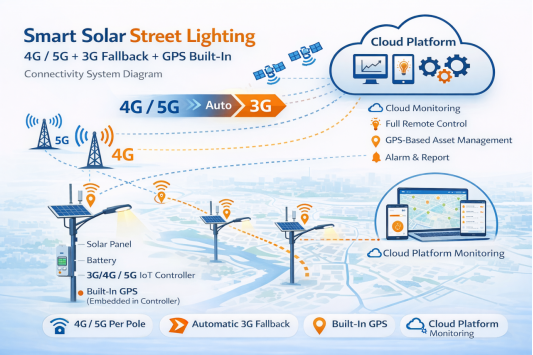
2. Core Architecture Concept
One Pole = One Independent Smart Node
In the Sunlurio system, each solar street light operates as an independent smart node, equipped with:
- Its own smart controller
- Its own cellular communication module
- Direct connection to the cloud platform
There is no gateway, no concentrator, and no mesh repeater in the system.
This architecture ensures:
- No single point of failure
- Easy system expansion
- Simple long-term maintenance
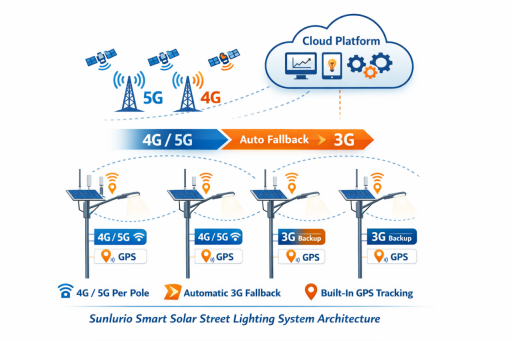
3. System Architecture Comparison
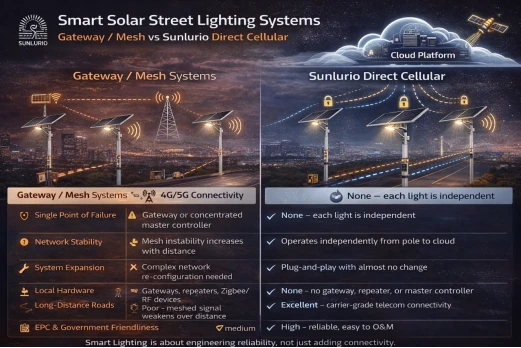
Gateway / Mesh Systems vs Sunlurio Direct Cellular Architecture
| Item | Gateway / Mesh Systems | Sunlurio Direct Cellular System |
|---|---|---|
| Network topology | Centralized or mesh-based | Fully decentralized |
| Connection method | Gateway + repeaters | 3G / 4G / 5G per pole |
| Single point of failure | Yes | None |
| Long-distance road performance | Poor | Excellent |
| System expansion | Complex reconfiguration | Plug and play |
| Local hardware | Gateway cabinets required | No local devices |
| Maintenance risk | High | Low |
| Project suitability | Small or demo projects | Government and EPC scale |
Sunlurio removes gateways to remove system risk.
4. Multi-Network Capability
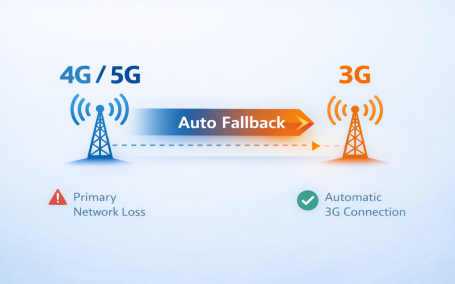
4G / 5G with Automatic 3G Fallback
In many regions, especially in developing markets:
- 4G or 5G coverage may be unstable
- Rural or airport access roads may have weak signals
- Network quality can change over time
Sunlurio systems are designed for network resilience rather than ideal network conditions.
Network Capability Comparison
| Feature | Standard Smart Lighting | Sunlurio Smart System |
|---|---|---|
| 4G / 5G support | Optional or limited | Standard |
| Automatic 3G fallback | Not supported | Supported |
| Weak signal handling | High offline risk | Optimized for stability |
| Communication chip strategy | Generic | Locally adapted |
| Always-online design | No | Yes |
Connection continuity is prioritized over peak data speed.
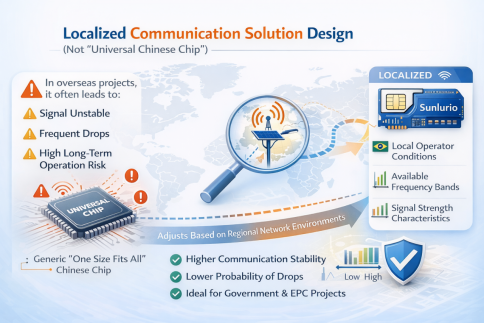
5. Locally Adapted Communication Design
Many smart lighting suppliers use generic communication chips designed primarily for the domestic Chinese market.
In overseas projects, this often results in:
- Poor signal performance
- Frequent disconnections
- Unstable long-term operation
Sunlurio adopts a different engineering approach.
Communication modules are selected and configured according to local network environments, including:
- Local telecom carriers
- Regional frequency bands
- Signal strength characteristics
This ensures stable, long-term connectivity in real project conditions.
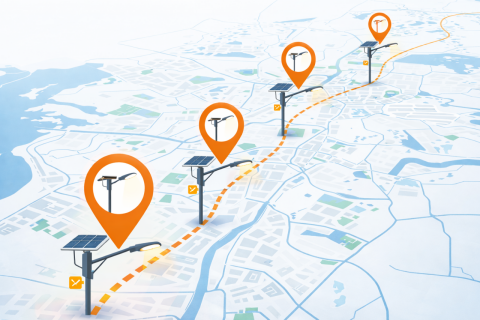
6. Integrated GPS at Pole Level (Optional by Project)
GPS is embedded directly into the controller architecture of each Sunlurio solar street light.
It is not an external add-on or gateway-based feature.
GPS Integration Comparison
| Feature | Typical Industry Practice | Sunlurio Approach |
|---|---|---|
| GPS integration method | External or gateway-based | Embedded in controller |
| Per-pole location accuracy | Inaccurate or manual | Precise |
| Asset identification | Manual | Automatic |
| Maintenance records | Fragmented | Location-based |
| Public infrastructure transparency | Limited | High |
Each light becomes a traceable infrastructure asset, not just a lighting point.
7. Cloud-Based Monitoring and Control
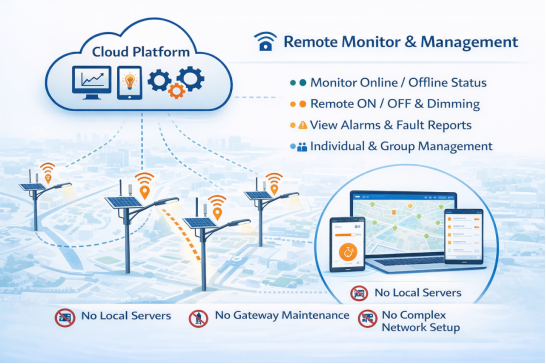
Through the cloud platform, operators can:
- Monitor online and offline status
- Remotely switch lights ON or OFF
- Adjust dimming profiles
- Receive alarms and fault notifications
- Manage lights individually or in groups
No local servers, gateways, or additional network hardware are required.
8. Operation and Maintenance Benefits
O&M Impact Comparison
| Aspect | Gateway / Mesh Systems | Sunlurio Direct System |
|---|---|---|
| Site visits | Frequent | Reduced |
| Fault isolation | Complex | Simple |
| System recovery | Manual | Automatic |
| Spare parts | Multiple device types | Minimal |
| Long-term operational cost | High | Lower |
Lower O&M cost is achieved through simpler system architecture, not cheaper hardware.
9. Typical Application Scenarios
The Sunlurio smart 4G / 5G solar lighting system is particularly suitable for:
- National and provincial highways
- Airport access roads
- Long-distance rural roads
- Border and security lighting projects
- Large-scale municipal lighting deployments
In these scenarios, gateway-based systems are more prone to failure, while decentralized cellular systems remain stable and scalable.
10. Key Takeaway for Clients
Sunlurio’s smart 4G / 5G solar street lighting system is not about using the newest technology.
It is about:
- Always-on connectivity
- No single point of failure
- Lower maintenance risk
- Long-term project reliability
Smart lighting is infrastructure, not electronics.
11. Engineering Support
Sunlurio provides:
- Communication architecture consultation
- Country-level network adaptation support
- System integration guidance
- Long-term operation and maintenance strategy support
Sunlurio Engineering Team


