

Real project stories, African field experience, and the quiet engineering truths behind modern solar street light system solutions.
2025 solar street lighting system solutions are no longer simple “solar lamps” but full off-grid power systems built with PV generation, LiFePO₄ storage, adaptive lighting, and optional IoT monitoring—designed for long-term reliability in harsh climates. What matters is no longer wattage, but system balance, thermal stability, and lifetime operation.
Why Are 2025 Solar Street Light Systems Becoming Full “System Solutions”?
Because today’s buyers aren’t asking “how bright?” but “how long will it survive?”
After 10+ years running around East, West, and Southern Africa—from Kigali’s hillside roads to Mombasa’s salty sea air—I’ve seen solar street lights evolve shockingly fast.
Ten years ago, customers only asked:
- “Is it bright?”
- “How many watts?”
Today, the questions sound like this:
- “How’s the battery decay after three rainy seasons?”
- “Do you have IoT alerts?”
- “What’s the controller’s thermal strategy?”
- “What’s the real lifetime, not catalogue lifetime?”
That shift alone tells you why solar street lighting is now a system engineering topic—not a single-lamp product.
A 2025 solar street lighting system solution typically includes:
- PV (power generation)
- LiFePO₄ or NMC batteries (energy storage)
- LED + optical lenses (energy consumption)
- Smart controller + sensors (energy management)
- Optional IoT (fleet-level administration)
It looks simple on paper. But after four rainy seasons in Uganda or Sierra Leone, the difference between a good system and a failed system becomes painfully clear.
How Does a Modern Solar Street Light System Really Work?
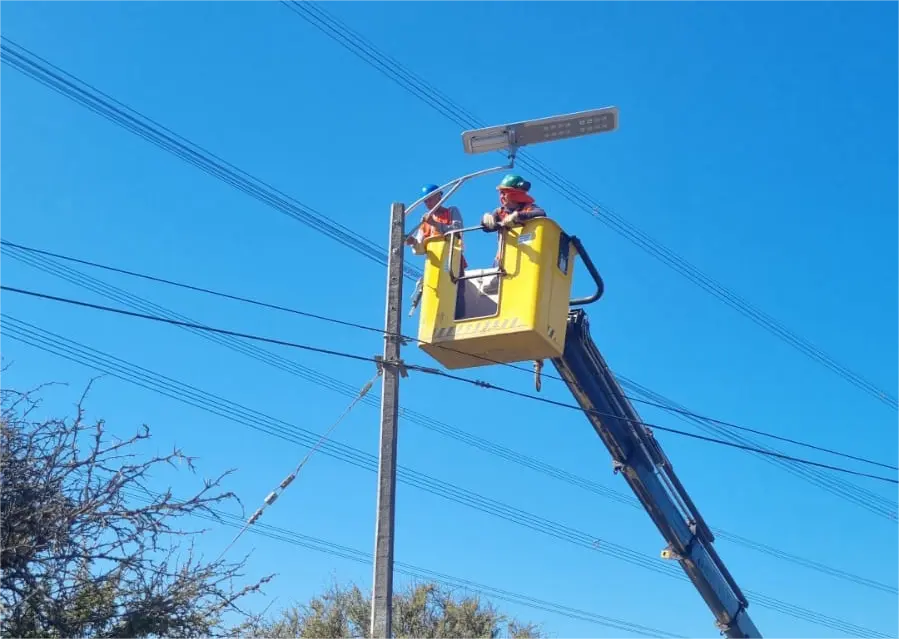
Not textbook theory—real engineering logic from actual African sites.
Solar lighting lifespan does NOT depend on “whether the lamp can turn on tonight.”
It depends on daily energy balance.
Here’s the real cycle:
1. What really happens during daytime power generation?
PV angle, size, dust, cloud cover—everything matters.
In Dar es Salaam or rural Accra, I often see 10–30% lower real output compared to factory “STC” data.
That’s why I always oversize PV slightly on projects with long rainy seasons.
2. How does charging and discharging quietly decide lifespan?
A good controller:
- Reduces charging current when temperature passes 45°C
- Avoids deep discharge
- Limits early-morning overcharge
A bad controller?
It kills batteries quietly in the first year.
3. How do sensors influence night-time energy usage?
Motion + ambient light sensors determine:
- How long the lamp stays bright
- How much energy must be saved for 2 AM–5 AM
- Whether the system will make it through cloudy weeks
Different countries expect different lighting habits—some want high brightness until midnight, others want dimming early to reduce “light pollution.”
I learned this the hard way in a Kenyan township project where residents said our lights were “too bright for sleeping.”
Yes, even brightness becomes political sometimes.
4. How important is IoT monitoring in 2025?
Cities that actually use IoT don’t care about “pretty dashboards.”
They only care about:
- Battery low alerts
- Panel failure warnings
- Over-temperature alarms
- Offline device reports
One procurement officer in Ghana told me:
“If your IoT cannot warn me early, then it’s useless.”
He’s right.
How to Choose Each Core Component (Lessons from Real Failures & Real Wins)

PV Panels: Why “Over-Matching” Is Often Necessary
Real power generation in Africa is always lower than datasheet numbers.
Dust, haze, rainy season—none of these appear in factory ratings.
In many Nairobi and Kampala projects, I add 20–30% PV margin and still find it tight during October rain.
Battery: The Most Painful Source of After-Sales Calls
More than 80% of failures I’ve seen since 2020 were battery-related.
- LiFePO₄ – Best for Africa. High cycle life, stable under heat.
- NMC – High energy density, but suffers rapid thermal decay.
- NiMH – Durable but bulky; rarely used now.
If batteries are installed in poorly ventilated spaces, brightness will drop noticeably after one hot season.
Smart Controller: The Quiet Hero (or the quiet killer)
Forget marketing features.
Three things matter:
- Is temperature protection accurate?
- Is lux threshold stable?
- Can it survive sudden current spikes?
In South Sudan, one corridor project lost 30 units due to unstable dusk/dawn detection—lights kept flickering, wasting precious battery energy.
LED & Optical Design: The Real Illuminance, Not the Catalogue
I’ve seen lamps claiming "200 lm/w" but performing worse than a 150 lm/w lamp with proper optics.
On-ground visibility depends on:
- Lens quality
- Light distribution pattern
- Heat dissipation design
- Road geometry
LED numbers alone mean very little.
Which Industry Trends Are Leading Solar Street Light Systems in 2025?
1. IoT Is Finally Becoming “Useful,” Not “Fancy”
Municipalities focus on fault alerts more than analytics.
2. Adaptive Lighting Is Becoming Standard
Perfect for:
- Coastal roads
- Community roads
- Areas with noise/light complaints
It saves energy AND reduces complaints.
3. More Energy-Efficient PV and LiFePO₄ Batteries
Not a gimmick—genuinely solves rainy-season anxiety.
4. Material Upgrades
Corrosion resistance, UV-resistant lenses, anti-theft fixtures—now standard.
5. Predictive Maintenance
Growing source of demand in projects with 1000+ units.
What Problems Happen Most in Real Projects?
(Every one of these I have personally stepped on)
1. Shading: The Silent System Killer
10% shade = 30% real power loss.
Happens a lot near:
- Schools
- Hospitals
- Community roads
2. Unstable Climate (Uganda, Sierra Leone, Rwanda)
Without oversizing PV/battery, failure is almost guaranteed.
3. Battery Thermal Decay
Poor installation or no airflow = brightness drop in 8–12 months.
4. IoT Signal Drops
Multi-network SIM helps.
But unreliable backend = useless IoT.
What Really Determines Cost & ROI of Solar Street Lighting?
(Based on how actual municipal tenders evaluate)
Cost drivers:
- PV panel size
- Battery type & capacity
- Pole height & foundation
- Controller intelligence
- IoT module (if required)
- Sea freight + inland transport
- Installation labor
In countries with higher electricity prices (Kenya, Senegal, Ghana), payback is 3–4 years.
Lower-tariff countries need longer.
Where Are Solar Street Light Systems Heading Next?
1. AI-Based Dimming
Adaptive algorithms based on motion trends and weather patterns.
2. Modular, Quick-Replacement Batteries
Less downtime, easier municipal maintenance.
3. Lighter & More Flexible PV
Better for bulk deployment in rural areas.
4. Microgrid Compatibility
Hybrid AC + solar street lighting will become common.
Conclusion: Why Solar Street Lighting Has Become the Default Choice
After so many projects, I genuinely believe:
Solar street lighting is no longer an alternative—it’s the default solution for many African countries.
Its value lies in:
- Fast installation
- Minimal maintenance
- Resilience during power outages
- Independence from unstable grids
For any city installing solar street lighting for the first time, I always recommend:
Do a small pilot and let the system survive one rainy season.
That tells more truth about a supplier than any datasheet or proposal.
Author: Yori Wang
Role: Senior Project & Sales Manager, Sunlurio
Experience: 15+ years in African solar lighting, municipal EPC support, and large-scale off-grid system design
Focus Regions: East Africa · West Africa · Southern Africa
Areas of Expertise: Solar street lighting systems, PV engineering, LiFePO₄ energy storage, IoT smart lighting, municipal project delivery, cost-risk analysis
All insights in this article are based on long-term field experience, real project data, and practical engineering results from African road lighting deployments.
Sunlurio – Reliable System Solutions for Real-World Projects
