Solar street lights can save money, but not simply because sunlight is free. For EPC contractors, municipal buyers, and infrastructure teams, the real saving usually comes from reducing trenching, cabling, grid extension, electricity bills, utility dependency, and repeated maintenance visits.
A solar street light project becomes economically strong when the full project cost is reviewed—not only the unit price of one lamp. The right question is not “How much does one solar street light cost?” The better question is: Will this system reduce the total life-cycle cost of the lighting project over its service period?
Quick Answer: When Do Solar Street Lights Save Money?
Solar street lights usually save money when the project site has high grid-extension cost, long cable routes, unstable electricity supply, remote maintenance conditions, or public-budget pressure to reduce operating expenses. They may not be the cheapest option when stable grid power already exists, trenching is simple, and the project only compares initial fixture prices.
In many municipal and road lighting projects, the purchase price of the lamp is only one part of the cost. A grid-connected street lighting project may also require cable trenches, conduits, distribution cabinets, meters, civil works, road cutting, reinstatement, and long-term electricity billing.
That is why solar street lighting should be evaluated as a life-cycle cost decision, not only as a product purchase.
The 4 Project Cost Areas That Decide Whether Solar Street Lights Save Money
A fair cost review should compare four major project cost areas:
- Trenching, cabling, and grid connection cost
- Electricity and utility dependency
- Maintenance and service access
- Battery replacement and rainy-season autonomy risk
Solar street lights usually become more economical when they reduce several of these cost areas at the same time. If a project only compares fixture purchase price, the result can be misleading.
A simple life-cycle cost review can be understood as:
Total project cost = product cost + civil/electrical installation cost + operating cost + maintenance cost + replacement risk + documentation and approval risk
For solar street lights, the product cost may be higher at the beginning, but the project may save money if it reduces grid extension, trenching, electricity billing, and maintenance travel. For grid-connected lighting, the fixture may be cheaper, but the total installed and operating cost may become higher when cable routes, civil works, and utility dependency are included.
Why Unit Price Alone Gives the Wrong Answer
The unit price of a solar street light is often higher than a basic grid-powered LED street light because the solar system includes a solar panel, battery, controller, luminaire, bracket, and energy-storage design. But unit price does not show the full project cost.
A low-cost grid fixture may still require expensive underground infrastructure. A higher-priced solar fixture may reduce cable work, electrical coordination, grid connection, and future utility payments.
For EPC and municipal projects, unit-price comparison often misses several important cost areas:
- Trenching and road cutting
- Underground cable and conduit
- Distribution cabinet and grid connection
- Transformer or utility coordination
- Electricity billing during operation
- Maintenance access and service visits
- Battery replacement planning
- Failure risk during rainy seasons
- Rework caused by under-specified systems
This is especially important for rural roads, municipal expansion roads, industrial access roads, parking areas, logistics zones, and public infrastructure projects where grid access is weak, distant, or expensive.
If your project is still comparing only fixture price, the evaluation is incomplete. A better approach is to compare installed cost + operating cost + maintenance cost + replacement risk.
Cost Area 1: Trenching, Cabling, and Grid Extension
Trenching and cabling are often the largest hidden costs in traditional street lighting projects. For long roads, remote sites, or areas with existing pavement, civil work can quickly become more expensive than expected.
A grid street light usually depends on underground cable routes, conduit protection, connection points, electrical cabinets, and sometimes road cutting. These works may also create schedule risk because they involve civil contractors, electrical contractors, utility coordination, and site reinstatement.
Solar street lights can reduce these costs because each pole has its own energy system. In many projects, this means:
- Less underground cable work
- Less road cutting and reinstatement
- Fewer grid-connection approvals
- Faster installation in remote or undeveloped areas
- Lower dependency on existing electrical infrastructure
This does not mean solar street lights have no installation cost. Poles, foundations, lifting, alignment, and commissioning still matter. But when grid extension is difficult or expensive, solar systems can create a clear economic advantage.
For projects where drawings, product data, and tender files must be reviewed before procurement, Sunlurio can support the early evaluation through an engineering support pack.
Cost Area 2: Electricity Bills and Utility Dependency
Solar street lights reduce electricity cost because they generate and store their own energy. For public lighting projects, this can lower long-term operating expenses and reduce exposure to unstable grid supply or future electricity price changes.
For municipalities, electricity billing is not only a technical issue. It is also a budget issue. Public lighting can become a recurring operational cost that continues every month after installation. In areas where public budgets are limited, a solar system can help reduce long-term operating pressure.
However, the saving must be calculated realistically. A solar street light still needs:
- Correct solar panel sizing
- Battery capacity matched to local conditions
- Efficient LED and optical design
- Suitable dimming profile
- Proper autonomy planning for rainy seasons
- Maintenance access for future service
A solar street light that is under-sized may look cheaper at purchase, but it can create higher costs later through battery failure, poor lighting performance, or frequent service visits.
This is why solar street lighting economics should be reviewed together with road width, pole height, lighting level, dimming schedule, local sunshine conditions, and rainy-season expectations.
Cost Area 3: Maintenance Cost Over the Project Life
Solar street light maintenance cost depends heavily on product quality, system architecture, battery life, installation quality, and spare-part planning. A well-designed system can reduce daily operating cost, but a poorly specified system can create repeated maintenance problems.
For EPC contractors, maintenance cost is not only about replacing parts. It also includes:
- Dispatching workers to the site
- Transport cost for remote locations
- Lifting equipment or ladder access
- Troubleshooting time
- Spare-part availability
- Warranty claims
- Client complaints after handover
- Reputation risk during the defect-liability period
This is why a cheap system can become expensive if it fails during the first rainy season or if battery replacement is required too early.
A good maintenance evaluation should ask:
- Is the battery type suitable for high-temperature operation?
- Is the battery capacity matched to the required autonomy?
- Can the luminaire, battery, and controller be serviced safely?
- Are replacement parts standardized across the project?
- Is there a clear inspection and handover checklist?
- Does the supplier provide datasheets, drawings, and configuration records?
For larger projects, buyers should ask for clear product documentation, not only sales pictures. Sunlurio provides datasheets and drawings to help EPC and municipal teams review configuration details before final selection.
Cost Area 4: Battery Replacement and Autonomy Planning
Battery replacement is one of the most important life-cycle cost factors in solar street lighting. If the battery is under-sized, exposed to excessive heat, or forced into deep discharge too often, replacement cost may appear much earlier than expected.
This is where many project cost calculations become unrealistic. Some proposals compare solar and grid lighting only by purchase price and electricity saving, but they do not check whether the battery system can survive the real operating environment.
A proper economic review should include:
- Local worst-month solar conditions
- Rainy-season duration
- Required lighting hours per night
- Dimming strategy
- Battery depth of discharge
- Battery temperature environment
- Battery replacement access
- Warranty and service responsibility
For Africa, the Middle East, and Southeast Asia, this point is especially important because many projects face heat, dust, rainy seasons, coastal exposure, weak maintenance access, or unstable grid conditions.
A solar street light system that performs well in ideal weather may still fail economically if it is not designed for the hardest operating months.
Solar Street Light vs Grid Street Light: Cost Comparison Points
A fair cost comparison should include both visible and hidden cost items. The best choice depends on the site, not on a single product price.
-
Fixture purchase cost
Grid LED fixtures are usually lower in purchase price. Solar street lights are usually higher because they include solar panel, battery, controller, bracket, and energy-storage components. -
Trenching and cabling
Grid street lights often require cable routes, conduits, road cutting, and electrical connection work. Solar street lights can reduce or avoid many of these civil and electrical works. -
Grid connection
Grid lighting depends on available power infrastructure and connection approval. Solar street lights operate independently and are often easier to deploy in weak-grid or off-grid areas. -
Electricity bill
Grid street lights create ongoing electricity cost. Solar street lights generate and store their own energy for lighting operation. -
Installation flexibility
Grid lighting layout is often limited by cable route and connection points. Solar lighting can be more flexible for remote roads, new development zones, parking areas, and public spaces. -
Maintenance focus
Grid lighting maintenance often involves electrical faults, cable issues, and utility dependency. Solar lighting maintenance focuses more on battery condition, controller performance, solar panel cleanliness, and system configuration. -
Main risk
Grid lighting risk often comes from civil work, grid dependency, cable faults, and electricity cost. Solar lighting risk often comes from under-sized batteries, weak solar panel margin, poor autonomy design, or low-quality components.
The economic benefit of solar street lighting is strongest when it reduces multiple cost items at the same time. If the only saving is electricity, the payback may be slower. If the system also avoids trenching, cabling, grid extension, and repeated maintenance travel, the business case becomes much stronger.
For project-level review, it is better to request a BOQ-aligned technical package instead of relying only on catalog pricing. Sunlurio supports tender teams with BOQ and tender document references for clearer procurement comparison.
When Solar Street Lights May Not Be the Cheapest Option
Solar street lights are not suitable for every project. They may not be the lowest-cost choice when stable grid power is already available, cable routes are short, electricity prices are low, and the project only needs a simple lighting upgrade.
They may also be a weak choice if the project requires very high lighting output but has limited solar-panel installation space, heavy shading, poor solar exposure, or strict architectural restrictions.
Common situations where solar may not be the best economic option include:
- Existing poles already have safe and stable grid power
- Cable routes are short and civil work is minimal
- Local electricity cost is very low
- The road has heavy tree shading or building obstruction
- The project requires high-power lighting with limited solar area
- The buyer only compares initial purchase cost
- The supplier cannot provide battery sizing logic
- The system is under-specified to win a low-price tender
This does not mean solar should be rejected. It means the project should be reviewed honestly. In some roads, grid LED lighting may be more economical. In other roads, solar lighting may be clearly better. In mixed infrastructure projects, a combination of grid LED, solar, and smart control may be the most practical solution.
Hidden Costs EPC Teams Should Check Before Procurement
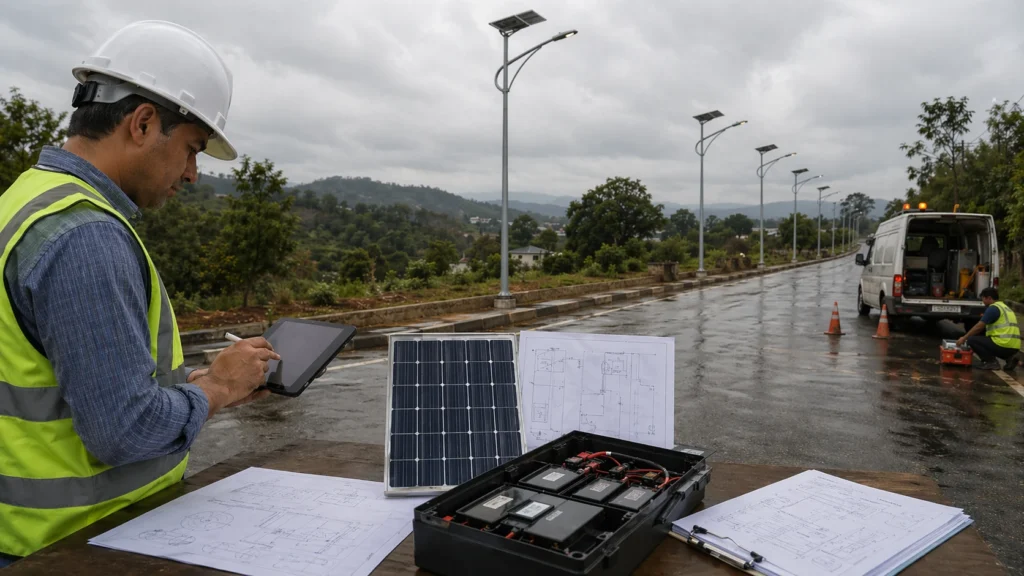
The biggest economic risk in solar street lighting is not always the product price. It is the cost of wrong assumptions. A project can look cheap during procurement but become expensive after installation if the system fails in real operating conditions.
Before procurement, EPC teams should check these hidden cost areas.
1. Under-Sized Battery
A smaller battery reduces purchase price, but it may increase failure risk during rainy seasons. If lights turn off early or batteries degrade quickly, maintenance and replacement costs can exceed the original saving.
2. Weak Solar Panel Margin
A solar panel should not be selected only for ideal-weather output. The system should be reviewed against local solar conditions, road lighting schedule, and recovery after consecutive cloudy days.
3. Poor Dimming Logic
Dimming can reduce energy consumption, but it must match road safety expectations. An aggressive dimming profile may save battery capacity on paper but create unacceptable lighting performance on site.
4. Incomplete BOQ Mapping
If the BOQ only says “solar street light” without clear model, pole height, battery capacity, panel size, optics, lighting mode, and installation scope, suppliers may quote different systems under the same item name.
5. Missing Lighting Simulation
Solar street lighting is not only an energy system. It is still a road lighting system. Pole spacing, optical distribution, road width, and mounting height should be reviewed before final procurement. For this reason, project teams can request DIALux simulation outputs when lighting performance needs to be checked.
6. No Spare-Part Plan
Large projects should consider whether batteries, controllers, luminaires, and brackets are standardized. If every batch uses different components, long-term maintenance becomes harder.
7. Weak Installation Review
Even a good product can fail if installation angle, pole alignment, foundation quality, or cable connection is poor. Installation details should be included in the handover and acceptance process.
What Information Is Needed for a Project Cost Review?
To compare solar street lights and grid street lights more realistically, project teams should prepare the basic project inputs before requesting a quotation. Without these inputs, suppliers may quote different assumptions, and the lowest price may not represent the lowest total cost.
Useful information includes:
- Project location and local climate condition
- Road type and road width
- Pole height and expected pole spacing
- Existing grid access condition
- Estimated cable route or trenching distance
- Required lighting hours per night
- Dimming schedule
- Rainy-season or cloudy-day requirement
- Maintenance access condition
- BOQ format or tender requirements
- Whether DIALux or lighting simulation is required
With these inputs, the comparison can move from a simple product price discussion to a project-level cost review. This helps EPC contractors and municipal buyers avoid unclear specifications, unrealistic autonomy claims, and under-sized systems that may create higher cost after installation.
If you already have road width, pole height, lighting hours, and BOQ requirements, you can send the project conditions for engineering review before comparing quotations.
How Sustainability and Cost Savings Connect in Solar Street Lighting
Sustainability and cost saving are connected when solar street lights reduce grid dependency, lower public electricity spending, and support reliable lighting in areas where electrical infrastructure is weak or expensive to extend.
For municipalities and public infrastructure teams, sustainable lighting should not only mean using renewable energy. It should also mean reducing long-term operating burden, improving night-time visibility, and supporting faster deployment in weak-grid roads, villages, parking areas, and public spaces.
Solar street lighting can support:
- Lower grid dependency
- Reduced public electricity spending
- Faster deployment in weak-grid areas
- More flexible infrastructure planning
- Lower exposure to some underground cable-related risks
However, sustainability should not be treated as a slogan. A low-quality solar street light that fails after one rainy season does not create real sustainability. It creates replacement cost, maintenance pressure, and public dissatisfaction.
A solar street lighting system is only sustainable when it is correctly sized, properly installed, realistically maintained, and supported with clear technical documentation.
For buyers who want to review real project examples, Sunlurio provides solar street lighting project references across different road and public lighting applications.
How Sunlurio Helps Buyers Evaluate Real Cost Savings
Sunlurio reviews solar street lighting projects from both the energy side and the project-delivery side. For EPC contractors and municipal buyers, the goal is not only to provide a lamp, but to help the project team compare real conditions before final specification.
For cost-sensitive projects, the review usually includes:
- Road type and road width
- Pole height and spacing assumptions
- Required lighting level
- Solar exposure and rainy-season conditions
- Battery and panel configuration
- Dimming schedule
- Product architecture selection
- BOQ matching
- Drawing and datasheet support
- Project handover and acceptance references
Different project sites may need different system types. A simple access road may use all-in-one solar street lights for easier installation. A higher-output municipal road may require all-in-two or split solar street light systems with more flexible panel and battery sizing.
Buyers can review broader solar street light system options before deciding which architecture is more suitable for their project.
For EPC and government projects, the most useful first step is not asking for the cheapest price. It is preparing the project conditions clearly enough for technical and commercial comparison.
Request an Engineering Support Pack to review product configuration, BOQ alignment, and project documentation before procurement.
Final Takeaway
Solar street lights can save money, but the saving comes from the whole project system, not from the lamp alone. The strongest economic benefit usually appears when solar lighting reduces trenching, cabling, grid extension, electricity bills, utility dependency, and maintenance travel.
For EPC and municipal projects, the correct decision should be based on life-cycle cost, not only unit price. A well-sized solar street light system may cost more at purchase, but it can become more economical when the project site makes grid infrastructure expensive or unreliable.
The best result comes from honest evaluation: check the road condition, grid situation, autonomy requirement, lighting performance, maintenance plan, and BOQ details before final procurement.
FAQ
Do solar street lights always save money?
No. Solar street lights save money when they reduce total project cost, not just electricity cost. They are usually more economical when grid extension, trenching, cabling, and maintenance access are expensive. If stable grid power already exists and civil work is simple, grid LED lighting may sometimes be cheaper.
Are solar street lights cheaper than grid street lights?
Solar street lights are usually not cheaper if only fixture purchase price is compared. They may become more economical when the project also considers trenching, cabling, grid connection, electricity bills, maintenance travel, and long-term replacement risk.
What affects the payback period of solar street lights?
The payback period depends on grid-extension cost, trenching and cabling cost, electricity price, maintenance access, battery replacement cycle, lighting schedule, and local solar conditions. A project with expensive cable work and weak grid access usually has a stronger economic case for solar lighting.
What is the biggest hidden cost in solar street lighting?
The biggest hidden cost is often under-sizing. A low-price system may use a smaller battery, weaker solar panel, or unrealistic dimming schedule. This can lead to poor rainy-season performance, early battery replacement, and repeated maintenance visits.
How should EPC teams compare solar street lights and grid street lights?
EPC teams should compare installed cost, operating cost, maintenance cost, replacement risk, and project schedule impact. The comparison should include trenching, cable, grid connection, electricity billing, battery replacement, and service access, not only fixture price.
Is battery replacement part of the life-cycle cost?
Yes. Battery replacement should always be included in solar street lighting life-cycle cost. The expected replacement cycle depends on battery type, capacity, temperature, depth of discharge, system design, and operating profile.
Are solar street lights good for municipal roads?
Solar street lights can be suitable for municipal roads when the system is sized correctly for road width, pole height, lighting requirement, solar condition, and maintenance reality. For wider or higher-traffic roads, buyers should request lighting simulation and technical configuration review before procurement.
Can solar street lights reduce cable theft risk?
In some project environments, solar street lights can reduce exposure to underground cable theft because each pole operates independently and does not require long power cable runs. However, anti-theft design, battery housing, installation height, and local site conditions still need to be considered.
What documents should buyers request before ordering?
Buyers should request product datasheets, technical drawings, battery and solar panel configuration, lighting distribution files, BOQ mapping, installation guidance, and project acceptance references. For larger road projects, DIALux or similar lighting simulation outputs are also recommended.
What is the best next step before procurement?
The best next step is to share road width, pole height, spacing expectation, project location, lighting hours, rainy-season requirement, and BOQ format with the supplier. This allows the project team to review whether the solar street light configuration is technically and economically suitable.